How does your company handle leave requests, late arrivals, salary changes, employee complaints, or exit processes?
If your company depends on verbal rules, scattered files, or different decisions from different managers, small HR issues can quickly become confusing. Employees may not know what rule applies, managers may handle the same issue differently, and HR may struggle to prove that every decision was fair.
HR policies in Nepal give your company written rules for hiring, attendance, leave, payroll, workplace behavior, discipline, safety, and exit processes. Clear policies help employees know what to expect and help employers make consistent decisions that support Nepal's labor rules.
This guide explains the key HR policies every employer in Nepal should prepare, what each policy should include, common mistakes to avoid, and how HR software can help companies apply policies in daily work.
Table of Contents
- What Are HR Policies?
- Why Are HR Policies Important in Nepal?
- 1. Support Labor Compliance
- 2. Create Fair and Consistent Decisions
- 3. Protect the Company During Disputes
- 4. Build a Professional Work Culture
- Key Laws and Rules Behind HR Policies in Nepal
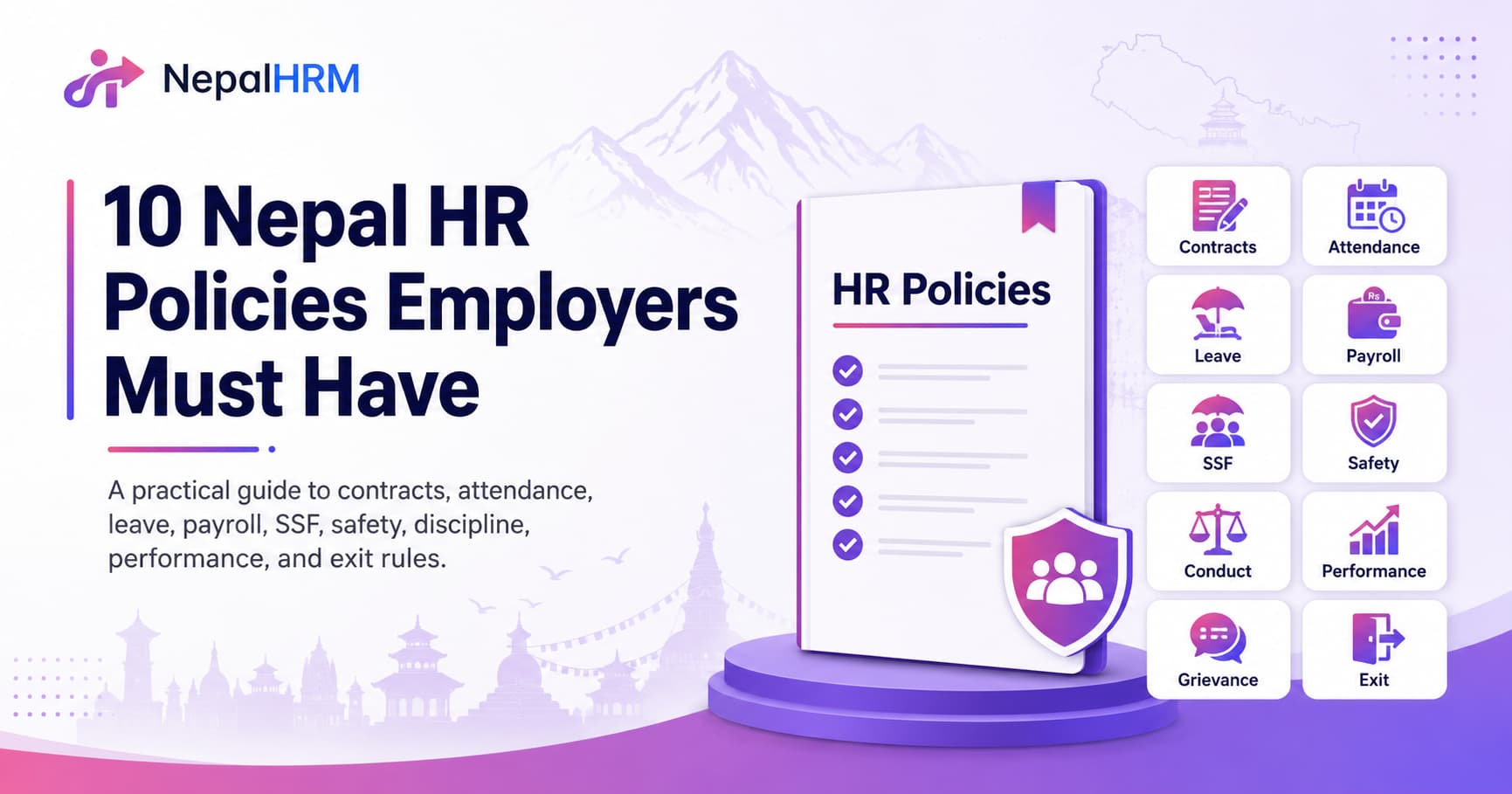
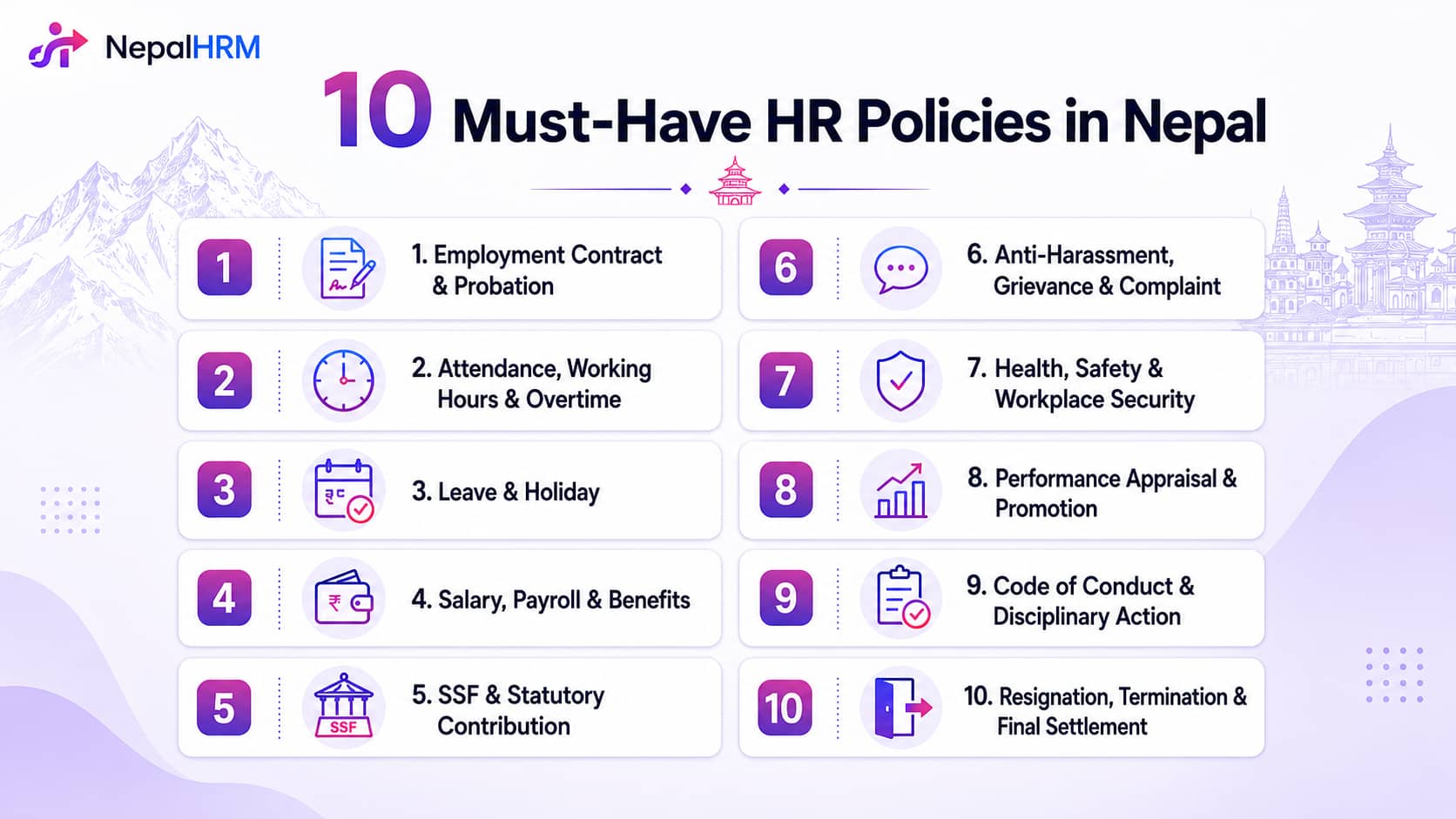
- 10 Must-Have HR Policies in Nepal
- 1. Employment Contract and Probation Policy
- 2. Attendance, Working Hours, and Overtime Policy
- 3. Leave and Holiday Policy
- 4. Salary, Payroll, and Benefits Policy
- 5. Social Security and Statutory Contribution Policy
- 6. Anti-Harassment, Grievance, and Complaint Policy
- 7. Health, Safety, and Workplace Security Policy
- 8. Performance Appraisal and Promotion Policy
- 9. Code of Conduct and Disciplinary Action Policy
- 10. Resignation, Termination, and Final Settlement Policy
- Simple HR Policy Document Structure
- How to Create HR Policies for Your Company in Nepal?
- 1. Review Nepal's Labor Rules First
- 2. Understand Your Company's Real Workplace Needs
- 3. Write Rules Employees Can Understand
- 4. Define the Process, Not Just the Rule
- 5. Keep Proper Records and Approvals
- 6. Share Policies With Employees
- 7. Review and Update Policies Regularly
- 1. No Written HR Policies
- 2. Copying Generic Templates without Customization
- 3. Not Updating Policies on Time
- 4. Weak SSF and Contribution Process
- 5. Poor Termination and Final Settlement Rules
- 6. Not Communicating Policies to Employees
- 7. Treating Leave Rules Too Casually
- 8. Ignoring Documentation
- Conclusion
What Are HR Policies?
HR policies are written rules that explain how a company manages employees and workplace decisions. They guide hiring, attendance, salary, leave, benefits, complaints, discipline, performance, and exit processes.
In Nepal, HR policies should reflect both internal company rules and legal requirements under Nepal's labor framework. Some policies depend on company culture, such as dress code or remote work. Other areas, such as employment contracts, working hours, leave, minimum wage, social security, and termination, need closer legal review.
Why Are HR Policies Important in Nepal?
HR policies help companies in Nepal manage employees fairly, reduce confusion, and keep proper records. Strong policies also help employers align daily HR decisions with labor rules and avoid inconsistent treatment across teams.
[Image suggestion: Importance of HR Policies in Nepal]
1. Support Labor Compliance
The Labor Act 2074 and Labor Rules 2075 guide many employment areas, including contracts, working hours, leave, wages, social security, workplace safety, and termination. Written HR policies help companies turn those requirements into daily procedures HR teams and managers can follow.
2. Create Fair and Consistent Decisions
Clear policies reduce guesswork. When rules for attendance, leave, salary, discipline, and exits are written, managers can apply the same process to every employee instead of making one-off decisions.
3. Protect the Company During Disputes
Written policies, signed documents, attendance records, leave approvals, warning letters, and payroll records help a company explain how a decision was made. Proper documentation is especially useful during employee complaints, audits, or legal review.
4. Build a Professional Work Culture
HR policies set expectations for behavior, communication, work hours, respect, safety, and responsibility. Employees work with more confidence when they know what the company expects from them and what support the company provides in return.
Key Laws and Rules Behind HR Policies in Nepal
The Labor Act 2074 is the main law that guides employment relationships in Nepal. It covers core areas such as employment terms, working hours, remuneration, leave, safety, discipline, social security, and termination.
The Labor Rules 2075 explain how several parts of the Labor Act should work in practice. HR teams should use both the Act and the Rules when preparing policies, especially for contracts, records, benefits, discipline, and workplace procedures.
Companies should also review related requirements such as Social Security Fund rules, minimum wage notices, tax obligations, industry-specific rules, and internal finance procedures before finalizing HR policy documents.
10 Must-Have HR Policies in Nepal
HR policies in Nepal should cover the rules employees face from hiring to exit. The list below gives employers a practical structure for building an employee handbook or internal HR policy document.
1. Employment Contract and Probation Policy
An employment contract policy explains how the company creates, signs, updates, and stores employment agreements. It should clearly state employment type, job role, salary terms, benefits, work location, probation, notice period, and basic responsibilities.
The Labor Act allows probation for up to six months, so the policy should explain how probation reviews work and what records HR will keep during that period. A clear contract policy protects both sides because the employee understands the job and the employer has a written record to refer to later.
What this policy should include:
·Type of employment, such as regular, time-based, work-based, part-time, or casual
·Job title, department, reporting manager, and main duties
·Salary, allowances, benefits, and payment cycle
·Working hours, overtime terms, and weekly off rules
·Leave entitlement and public holiday rules
·Probation period, review process, and confirmation process
·Notice period, resignation process, and termination terms
·SSF, PF, CIT, insurance, or other contribution details where applicable
2. Attendance, Working Hours, and Overtime Policy
An attendance policy tells employees when work starts, how attendance gets recorded, and how HR handles late arrivals, early exits, missed punches, and absence without approval. Attendance rules also affect salary, leave, overtime, and discipline, so they need proper records.
Nepal's labor framework sets regular working-hour standards for adult workers and requires proper handling of overtime. The policy should define the approval process before extra work happens, not after the salary cycle becomes messy.
What this policy should include:
·Office hours, workdays, weekly off days, and break rules
·Attendance method, such as biometric, web, mobile, GPS, or manual record
·Late arrival, early exit, half-day, and absence rules
·Missed punch or attendance correction process
·Shift schedule and roster process, if applicable
·Overtime request, approval, record, and payment process
·Remote work, field attendance, and travel attendance rules
·Attendance records used for payroll and disciplinary review
3. Leave and Holiday Policy
A leave policy explains the types of leave employees can take, how they should request leave, who approves it, and how HR tracks balances. Without a written leave policy, teams often depend on messages, verbal approvals, or different manager rules.
The policy should also explain public holidays, weekly off days, sick leave documents, unpaid leave, emergency leave, carry-forward rules, and encashment rules. Clear leave records help HR avoid payroll confusion and employee disputes.
What this policy should include:
·Types of leave available to employees
·Eligibility and yearly leave entitlement
·Leave request and approval steps
·Sick leave document requirements
·Maternity, paternity, mourning, and other special leave rules
·Public holiday and weekly off rules
·Leave carry forward, encashment, and lapse rules
·Emergency leave and unpaid leave process
4. Salary, Payroll, and Benefits Policy
Salary is one of the most sensitive parts of employment. A payroll policy explains how the company calculates salary, when payment happens, what deductions apply, and how employees receive pay slips.
This policy helps HR and finance follow the same process. It should cover salary structure, allowances, overtime, tax, statutory deductions, advances, loans, bonuses, increments, and final settlement rules.
What this policy should include:
·Salary structure and basic salary details
·Allowances, benefits, bonuses, and festival expenses
·Payroll cycle and salary payment date
·Overtime calculation and payment process
·Tax, PF, CIT, SSF, loan, and advance salary deductions
·Pay slip format and salary record process
·Annual increment and salary revision process
·Final settlement rules during exit
5. Social Security and Statutory Contribution Policy
Employees should understand statutory deductions before they see them on a pay slip. A social security and contribution policy explains what deductions apply, why they apply, where the amount goes, and what benefits the employee may receive.
For SSF, the commonly used contribution structure is 11% from the employee and 20% from the employer, making 31% of the basic salary. Companies should confirm the latest contribution rules and apply them consistently in payroll.
What this policy should include:
·SSF registration and contribution process
·Employee and employer contribution details
·PF, gratuity, CIT, insurance, and other benefit rules where applicable
·Monthly deduction, deposit, and reconciliation process
·Employee benefit explanation
·Recordkeeping and reporting process
·Correction process for wrong deductions
·Exit-related contribution and settlement rules
6. Anti-Harassment, Grievance, and Complaint Policy
Employees should know where to report harassment, bullying, discrimination, threats, or unfair treatment. A complaint policy gives HR a clear way to receive, review, and resolve sensitive issues.
This policy also helps protect employees from retaliation and helps the company investigate complaints fairly. The process should be simple enough for employees to follow without fear or confusion.
What this policy should include:
·Meaning of harassment, bullying, discrimination, and grievance
·Examples of unacceptable workplace behavior
·Complaint reporting channels
·Review and investigation process
·Confidentiality rules
·Protection against retaliation
·Action against false or harmful complaints
·Disciplinary action after confirmed misconduct
7. Health, Safety, and Workplace Security Policy
A health and safety policy does not only matter for factories or construction sites. Offices also need rules for fire safety, electrical risks, emergency exits, first aid, hygiene, equipment use, and safe work practices.
The policy shows employees that the company takes safety seriously. It also gives managers and HR a clear process for incident reporting, emergency action, and safety training.
What this policy should include:
·Workplace safety rules
·Employer and employee safety responsibilities
·Accident and incident reporting process
·Emergency contact and evacuation steps
·First aid and medical support rules
·Equipment and workstation safety
·Hygiene and health-related rules
·Safety training and awareness process
8. Performance Appraisal and Promotion Policy
A performance policy helps the company review employees fairly instead of depending only on personal judgment. It creates a written process for goals, feedback, ratings, training needs, promotions, and increments.
Performance-based decisions should be backed by clear expectations and records. This is especially important when appraisal results affect salary, promotion, transfer, probation confirmation, or performance improvement plans.
What this policy should include:
·Appraisal cycle, such as quarterly, half-yearly, or annual
·Role-based goals and key performance indicators
·Goal-setting process
·Supervisor review and employee self-review
·Rating method and feedback process
·Training, improvement, or support plan
·Connection with increment, promotion, transfer, or confirmation
·Employee disagreement and review process
9. Code of Conduct and Disciplinary Action Policy
A code of conduct explains how employees should behave at work. It covers punctuality, respect, confidentiality, company property, communication, conflict of interest, fraud, harassment, intoxication, and misuse of systems.
The disciplinary action policy should explain what happens when someone breaks a rule. A fair process gives the employee a chance to respond, helps HR document the issue, and reduces the risk of inconsistent action.
What this policy should include:
·Expected workplace behavior
·Attendance and punctuality rules
·Respectful workplace standards
·Rules against harassment, discrimination, violence, bribery, theft, fraud, and intoxication
·Confidentiality and data protection duties
·Company property and IT system use
·Conflict of interest rules
·Warning, suspension, salary deduction, withholding increment, dismissal, or other action where legally allowed
·Right to respond, documentation, and appeal process
10. Resignation, Termination, and Final Settlement Policy
Exit processes carry high risk because they affect salary, benefits, documents, company property, and future disputes. A written policy helps the company handle resignation, contract expiry, poor performance, misconduct, retirement, retrenchment, and final settlement in a consistent way.
The policy should explain legal grounds, notice requirements, documentation, handover, unpaid salary, leave encashment, benefits, and experience letters. Companies should confirm final wording with legal guidance because termination rules can be sensitive.
What this policy should include:
·Resignation process and notice period
·Termination grounds and approval process
·Contract expiry process for fixed-term or work-based employment
·Poor performance review process
·Misconduct investigation process
·Retirement and retrenchment rules where applicable
·Notice pay, unpaid salary, leave encashment, benefits, and final settlement
·Return of company property and access removal
·Experience letter or service certificate process
·Recordkeeping for future disputes
Keep HR policies clear, consistent, and easy to apply NepalHRM helps companies in Nepal manage attendance, leave, payroll, employee records, documents, approvals, and daily HR work from one connected platform. |
Simple HR Policy Document Structure
A good HR policy should not only state a rule. It should also explain who the rule applies to, what steps employees should follow, who approves the request, and what records HR must keep.
Policy section | What to write |
Purpose | Explain why the policy exists. |
Scope | Mention who the policy applies to. |
Rules | State the main rules in simple language. |
Process | Explain how employees or managers should act. |
Approval authority | Name who can approve, reject, or escalate the matter. |
Documents and records | List the forms, files, approvals, or system records HR must keep. |
Exceptions | Explain when exceptions may apply and who can approve them. |
Review date | Mention when HR will review or update the policy. |
How to Create HR Policies for Your Company in Nepal?
To create HR policies in Nepal, start with legal requirements, then match the rules with your company's real work process. A policy should be legally aware, practical, easy to read, and simple for employees to follow.
1. Review Nepal's Labor Rules First
Check the rules that apply to contracts, working hours, overtime, minimum wage, leave, SSF, safety, discipline, and termination. Starting with the law helps your company avoid internal rules that sound practical but create legal risk.
2. Understand Your Company's Real Workplace Needs
A small office may need simple policies for attendance, leave, payroll, and conduct. A larger company may need detailed rules for shifts, departments, remote work, assets, travel, reimbursements, and approvals.
3. Write Rules Employees Can Understand
Use simple words and direct instructions. Instead of writing "absence shall be treated as unauthorized," write "HR will mark an absence as unauthorized if the employee misses work without approval."
4. Define the Process, Not Just the Rule
If employees can apply for leave, explain where to apply, when to apply, who approves it, and what documents may be required. A clear process helps HR apply the same rule every time.
5. Keep Proper Records and Approvals
Keep records for contracts, attendance, leave, payroll, warnings, complaints, appraisals, assets, and exits. Written records help HR explain decisions during audits, disputes, and internal reviews.
6. Share Policies With Employees
HR policies should not stay hidden in a folder. Share them during onboarding, explain key rules in simple language, and collect employee acknowledgment after employees read them.
7. Review and Update Policies Regularly
Review policies whenever labor rules, salary structures, benefits, work models, or company processes change. A yearly review helps HR keep policies accurate and useful.
Common HR Policy Mistakes Companies Make
Companies often make HR policy mistakes by using generic templates, unclear employment terms, weak leave and overtime rules, and inconsistent disciplinary procedures. They also forget to update policies when labor rules, benefits, or company processes change.
1. No Written HR Policies
Verbal rules are hard to prove and easy to apply unevenly. When a dispute happens, HR needs written policies, signed records, and clear approvals to explain the company's decision.
2. Copying Generic Templates without Customization
A copied policy may look complete, but it may not match Nepal's labor rules or your actual work process. Your policy should reflect your team size, work hours, leave system, payroll structure, and approval steps.
3. Not Updating Policies on Time
Old policies can create problems when minimum wage, benefit rules, salary structures, or company processes change. HR should review policies regularly instead of using the same handbook for years.
4. Weak SSF and Contribution Process
SSF and other statutory contributions should be clear in the payroll policy. Wrong deductions, missed deposits, or unclear explanations can create confusion for employees and extra work for finance.
5. Poor Termination and Final Settlement Rules
Termination, resignation, and final settlement need careful documentation. A weak policy can lead to unclear notice, delayed payments, missing handover, or disputes after the employee leaves.
6. Not Communicating Policies to Employees
A policy does not help if employees never read it. HR should share policies during onboarding, keep the latest version accessible, and record employee acknowledgment.
7. Treating Leave Rules Too Casually
Leave rules should be clear and consistent. If one manager approves leave informally and another rejects the same request, employees lose trust, and HR records become unreliable.
8. Ignoring Documentation
HR should document contracts, attendance changes, leave approvals, salary changes, warnings, complaints, appraisals, assets, and exits. Documentation protects both the company and the employee.
Conclusion
HR policies in Nepal help companies manage people with clarity, fairness, and better records. Strong policies explain how the company handles contracts, attendance, leave, salary, SSF, complaints, safety, performance, discipline, and exit processes.
A useful HR policy is simple, practical, and easy to follow. It should match Nepal's labor rules, reflect your company's real workflow, and guide both employees and managers through the right process.
NepalHRM helps businesses apply these policies in daily work. HR teams can manage records, attendance, leave, payroll, documents, approvals, onboarding, offboarding, and reports from one place, so workplace rules do not stay trapped in a document no one uses.
Start with NepalHRM for free.