

HR software pricing in Nepal is not always easy to compare. Some vendors show a clear per-employee rate, some sell yearly packages, and some share pricing only after a demo.
That creates one simple question for business owners, HR managers, and finance teams: how much should a company expect to pay for HR software in Nepal?
The answer depends on more than the monthly subscription. A company also needs to check payroll features, biometric attendance setup, VAT, data migration, support, and whether Nepal-specific payroll rules are already built into the system.
Table of Contents
- Common HR Software Pricing Models in Nepal
- Per-Employee Monthly Pricing
- Yearly Package Pricing
- Module-Based Pricing
- Custom HR Software Pricing
- What You Usually Get at Each Price Point
- HR Software Cost Examples by Company Size
- What Affects HR Software Pricing in Nepal?
- Employee Count
- Payroll Features
- Attendance and Biometric Setup
- Reports and Finance Needs
- Extra Modules
- Setup, Migration, and Support
- Contract Terms
- The Real Cost of Nepal Payroll Compliance
- Hidden Costs That Can Change the Final Price
- Local HR Software vs Global HR Software Cost in Nepal
- Cloud HRMS vs Custom HR Software Cost in Nepal
- How to Calculate the Real Cost of HR Software
- Questions to Ask Before You Pay for HR Software
- How Much Does NepalHRM Cost?
- Final Thoughts
Common HR Software Pricing Models in Nepal
HR software vendors in Nepal usually follow per-employee pricing, yearly package pricing, module-based pricing, or custom pricing. Each pricing model can work, but the right choice depends on your team size, payroll process, and how much manual work the system replaces.
Per-Employee Monthly Pricing
Per-employee pricing means your company pays for each active employee in the system. This model is common for cloud HRMS because the cost grows with your team.
For example, if the system costs NPR 100 per employee per month, a company with 50 active employees pays NPR 5,000 per month before VAT. This model works well when you want a clear monthly HRMS budget.
Yearly Package Pricing
Yearly package pricing gives your company a fixed annual cost for a selected plan. It can work well when your employee count is stable, and your team wants predictable yearly spending.
The main risk is feature limits. A low yearly price may not include payroll, biometric setup, training, data migration, or support. Always check what the annual fee actually includes.
Module-Based Pricing
Module-based pricing means the vendor charges separately for extra features. A base plan may include employee records, attendance, and leave, while payroll, recruitment, performance, helpdesk, biometric integration, or advanced reports may cost extra.
This model can look affordable at first. The final cost can increase when your company adds the modules it actually needs.
Custom HR Software Pricing
Custom pricing is common when a company needs special workflows, private hosting, custom reports, integrations, or on-premise setup. This option usually has a higher starting cost and a longer setup timeline.
Custom software can make sense for large companies with complex internal processes. For most small and mid-sized Nepali businesses, cloud HRMS is usually easier to start because the company can pay monthly or yearly without a large upfront investment.
What You Usually Get at Each Price Point
HR software pricing makes sense only when you know what the plan includes. A cheap plan may be enough for basic HR work, but a growing company may need payroll, approvals, employee self-service, and reports from the beginning.
Monthly Price Range | What It Usually Covers | What to Check |
NPR 0 to NPR 100 per employee/month | Basic employee records, attendance, leave, limited reports, and simple employee access. | Whether payroll, biometric devices, support, and exports are included. |
NPR 150 to NPR 300 per employee/month | Payroll, tax tools, approvals, employee self-service, mobile access, and stronger reports. | Whether Nepal payroll items such as PF, CIT, SSF, eTDS, and salary sheets are built in. |
NPR 300 to NPR 500 per employee/month | Advanced reports, performance, recruitment, integrations, enterprise controls, and wider support. | Whether the extra modules replace manual work or add cost. |
Custom pricing | Private setup, custom workflows, special reports, integrations, migration help, or dedicated support. | Implementation timeline, service level, data export, and total first-year cost. |
Key Takeaway: Do not compare HRMS pricing only by the monthly rate. Compare what your team gets for that rate and how much manual work the system removes.
HR Software Cost Examples by Company Size
Company size has a direct impact on HR software cost. A small company may only need employee records, attendance, leave, and basic salary records. A larger company may need advanced payroll, reports, role permissions, biometric sync, recruitment, and multi-company support.
Here is a simple monthly cost example using NepalHRM pricing:
Company Size | Example Pricing | Estimated Monthly Cost |
5 employees | Free plan (up to 10 employees) | NPR 0 |
10 employees | Free plan (up to 10 employees) | NPR 0 |
25 employees | Essential: NPR 60/employee/month | Essential: NPR 1,500 |
50 employees | Essential: NPR 60/employee/month | Essential: NPR 3,000 |
100 employees | Essential: NPR 56/employee/month | Essential: NPR 5,600 |
250 employees | Essential: NPR 56/employee/month | Essential: NPR 14,000 |
300 employees | Essential: NPR 56/employee/month | Essential: NPR 16,800 |
These examples apply the relevant plan rate to the company's full active employee count. NepalHRM's volume discounts apply automatically to the whole team after each threshold is crossed. Prices exclude 13% VAT. Free onboarding and data migration are included, while biometric hardware and its one-time setup fee are billed separately. The optional Activity Tracker costs NPR 250 per selected employee per month.
What Affects HR Software Pricing in Nepal?
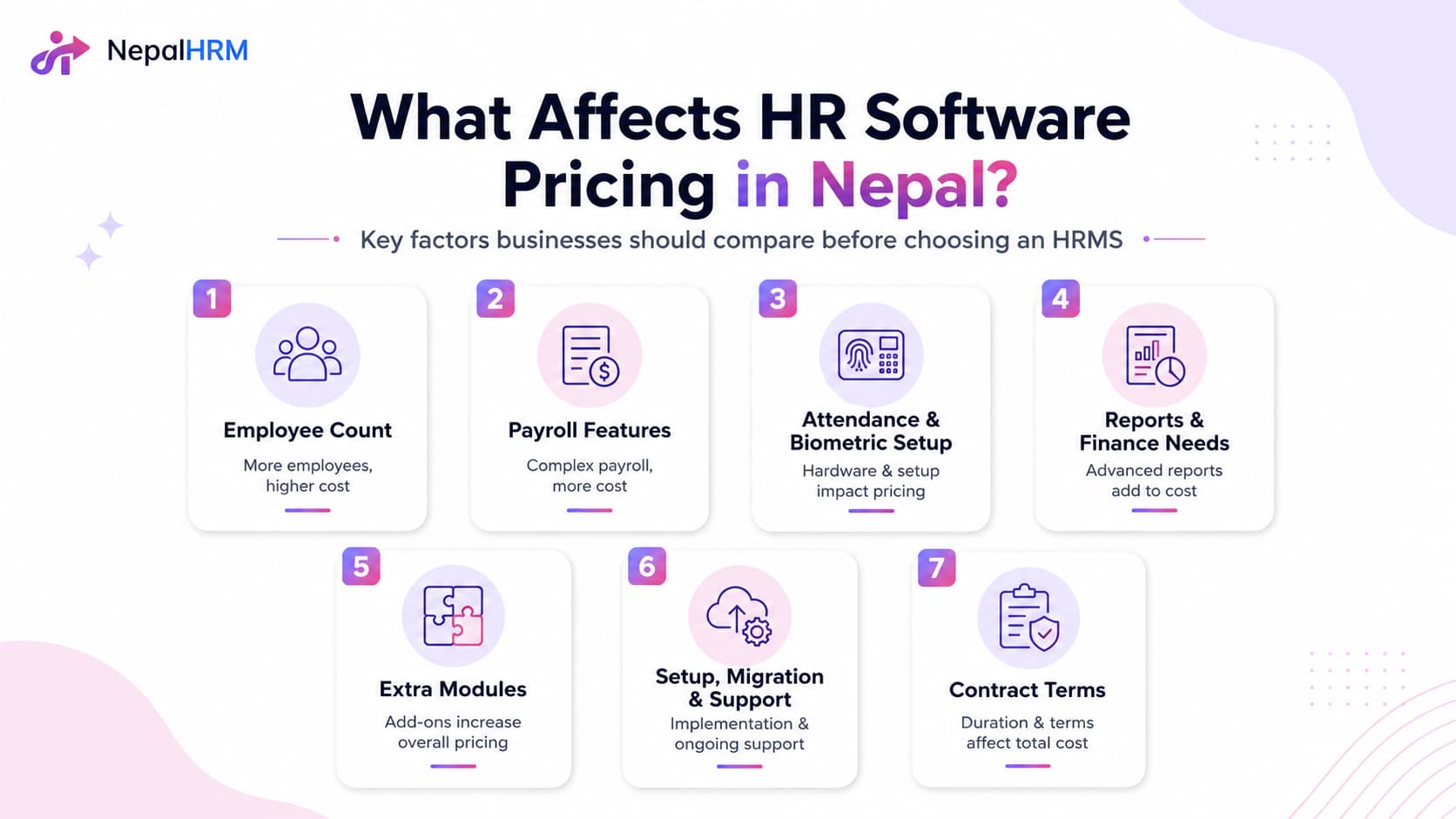
HR software pricing in Nepal changes based on how much work the system handles for your company. Employee count affects the base cost, but payroll, attendance setup, reporting needs, support, contract terms, and extra modules often make the bigger difference.
Employee Count
Employee count is usually the first factor that affects HR software pricing. If the vendor uses per-employee pricing, your monthly cost increases as your team grows. Fixed yearly packages may stay stable for a while, but they usually have employee or user limits.
Payroll Features
Salary tools can change the final price because they add more rules, calculations, deductions, and financial records. In Nepal, companies may need tax slabs, PF, CIT, SSF, eTDS, payslips, advances, reimbursements, and salary sheets.
Attendance and Biometric Setup
Attendance tools can also affect the final price. Basic web or mobile attendance may come with the plan, but biometric devices, GPS check-ins, shift rules, late alerts, and device mapping may need extra setup or support.
Reports and Finance Needs
Basic summaries may be enough for small teams, but growing companies usually need finance-ready data. Salary sheets, PF records, eTDS data, attendance summaries, leave balances, and department-wise reports can all affect the plan value.
Extra Modules
Some HR software plans include only core HR tools. Others include recruitment, onboarding, offboarding, performance, helpdesk, asset management, shift management, and employee self-service. A higher plan can be better value if it replaces several separate tools.
Setup, Migration, and Support
Setup and migration can affect the first-year cost. Your company may need help adding employees, importing old records, setting leave balances, creating salary structures, mapping biometric devices, and training HR or finance users.
Contract Terms
Monthly plans give more flexibility, while yearly plans may reduce the monthly cost. A free trial or monthly plan helps your team test whether the software actually fits daily HR and payroll work before signing a long contract.
The Real Cost of Nepal Payroll Compliance
Nepal payroll needs more than basic salary calculation. Companies may need to manage income tax slabs, PF, CIT, SSF, eTDS reports, salary sheets, payslips, and other finance records based on their legal setup and internal policy.
When HR software does not support these needs, the work usually moves back to spreadsheets. Finance teams may calculate tax manually, prepare eTDS data separately, check PF or CIT records outside the system, and review salary details again before payment.
That extra work takes time every month. It can also lead to correction work, filing delays, or employee salary disputes when records do not match.
NepalHRM helps reduce that manual work by keeping Nepal-focused salary tools, tax settings, PF, CIT, SSF, eTDS, salary structures, payslips, and finance reports inside the same system. The CIT Optimizer also helps estimate a suitable CIT contribution based on configured tax rules.
Hidden Costs That Can Change the Final Price
The monthly price is not always the full HR software cost. First-time setup, data migration, biometric connection, salary configuration, support, VAT, and renewal terms can change the final amount.
For example, a plan may look affordable at NPR 100 per employee per month. Still, the first-year cost can increase if the vendor charges separately for training, employee import, biometric setup, or salary structure configuration.
✓ Employee data import and cleanup
✓ Leave balance setup
✓ Salary structure and payroll configuration
✓ Biometric device connection or device purchase
✓ Training for HR, managers, finance, and employees
✓ Custom reports, approval workflows, or integrations
✓ Support beyond email or chat
✓ VAT and invoice terms
✓ Data export if your company leaves the system
A clear vendor should explain the full first-year cost before your company pays. If pricing is unclear, your company may face extra charges later.
Local HR Software vs Global HR Software Cost in Nepal
Global HR software can work well for international teams, but Nepali businesses should check whether it supports Nepali payroll, local reports, biometric attendance, and local support.
A global HR tool may support general payroll, but your team may still need extra setup for Nepali tax slabs, PF, CIT, SSF, eTDS formats, and local attendance rules. If those items need manual work or outside help, the lower monthly price may not reduce the actual workload.
A local HRMS may offer better value when Nepal-focused salary, attendance, leave, and finance reports are already included. The better choice is not always the lowest monthly price. The better choice is the system that reduces setup work, manual payroll checks, and repeated reporting tasks.
Cloud HRMS vs Custom HR Software Cost in Nepal
Cloud HRMS usually costs less upfront because businesses pay monthly or yearly. Custom HR software usually needs a higher starting budget, longer setup time, and ongoing maintenance.
Factor | Cloud HRMS | Custom HR Software |
Starting cost | Lower | Higher |
Setup time | Faster | Slower |
Payment style | Monthly or yearly | One-time or custom quote |
Updates | Usually handled by vendor | May need extra work |
Maintenance | Vendor managed | Company or vendor managed |
Best fit | Small and growing teams | Large companies with complex needs |
Most small and medium businesses in Nepal can start faster with cloud HRMS. Custom HR software may make sense when your company has unique workflows that standard HRMS tools cannot support.
How to Calculate the Real Cost of HR Software
The real cost of HR software is not only the monthly plan price. Your company should calculate the full yearly cost by adding subscription fees, VAT, setup, migration, training, biometric setup, payroll needs, and any paid add-ons.
✓ Monthly HRMS cost = active employees × monthly price per employee
✓ Yearly HRMS cost = monthly cost × 12 + VAT + one-time costs
✓ Two-year HRMS cost = monthly cost × 24 + VAT + setup and migration costs
For example, if your company has 50 employees and the system costs NPR 100 per employee per month, the monthly cost is NPR 5,000. The yearly subscription becomes NPR 60,000 before VAT and any one-time setup charges.
The two-year formula gives a clearer picture because setup and migration costs usually happen at the beginning. A plan that looks cheaper in the first month may not stay cheaper after setup fees, add-ons, and manual work are included.
Questions to Ask Before You Pay for HR Software
A demo should not only show attractive dashboards. Please use the demo to confirm pricing, support, payroll setup, data ownership, and daily workflow fit.
✓ Is pricing based on employees, users, seats, modules, or a fixed package?
✓ Are inactive employees, admins, managers, or resigned employees charged?
✓ Does the plan include payroll, PF, CIT, SSF, eTDS, payslips, and salary sheets?
✓ Are biometric devices, GPS attendance, shifts, and overtime included?
✓ Is employee data import included in the setup?
✓ Does the vendor help configure leave balances and salary structures?
✓ What support channels are included in the plan?
✓ Is VAT included or added separately?
✓ Can your company export employee, attendance, leave, and payroll data?
✓ Can you cancel monthly, or does the contract lock you in for a year?
How Much Does NepalHRM Cost?
NepalHRM uses transparent per-active-employee pricing for Nepali companies. Teams with up to 10 employees can use the Free plan, while growing companies can choose Essential or Business and receive automatic volume discounts as their active employee count increases.
Plan | Price | Main Notes |
Free | NPR 0 forever | For teams with up to 10 active employees. Every feature is included, along with one biometric device. |
Essential | NPR 60 per active employee/month | Employee, attendance, and leave management. The rate drops to NPR 56 per employee above 50 employees. Includes a 1-month free trial. |
Business | NPR 99 per active employee/month | Full Nepal payroll and the complete HR suite. The rate drops to NPR 89 above 100 employees and NPR 79 above 200. Includes a 1-month free trial. |
Enterprise | Custom pricing | For multi-company organizations and teams with 350 or more employees, with dedicated support and the uptime commitment set out in our terms. |
VAT | 13% added to paid plans | Displayed prices exclude VAT. Annual billing includes two months free. |
Essential and Business include a 1-month free trial with no credit card required. Annual billing includes two months free. During the trial, your team can test daily HR work, attendance, leave, payroll, reports, and other included features before committing.
NepalHRM's clear pricing helps businesses estimate monthly costs before asking for a custom quote or signing a long contract.
Final Thoughts
HR software pricing in Nepal is not only about the monthly subscription. The real cost includes setup, payroll gaps, biometric needs, VAT, support, and the time your team spends working around system limitations.
A low-cost plan can work well for simple HR needs, but a complete HRMS may offer better value when it replaces manual payroll work, attendance tracking, reports, leave approvals, and employee data management.
For Nepali businesses that want clear pricing and local payroll support, NepalHRM provides a simple starting point. Teams with up to 10 employees can start free, while growing companies can choose Essential or Business and move automatically to lower volume rates as they expand. Sign up today!!


