Experience Letter and Experience Certificate Format
A Nepali experience letter with the service dates in both BS and AD, the employment type, and the length of service worked out for you. Section 150 of the Labour Act 2074 says what it must state; the rest is your choice.
- BS and AD dates
- Section 150 minimum labelled
- PDF or Word
- Nothing leaves your browser
What the Labour Act says about it
- Owed on request after leaving
- Section 150
- All it must state
- Period + post
- To settle dues, Section 148
- 15 days
- Of employment, Section 10(1)
- 5 types
The employee and the post
Employment of any type other than work-based, time-based or casual. The default, and the one every entitlement in this Act is written around.
Service dates
What else the letter says
EXPERIENCE CERTIFICATE
This is to certify that Sujata Shrestha was employed with Your Company Pvt. Ltd. as Senior Accountant in the Finance department from 1 Shrawan 2079 BS (17 July 2022) to 15 Ashwin 2083 BS (1 October 2026), a period of 4 years, 2 months and 15 days.
The employment was regular employment.
During this period Sujata Shrestha was responsible for the monthly accounts close, VAT returns and the payroll reconciliation.
We found Sujata Shrestha sincere and diligent, and of good conduct throughout.
We wish Sujata Shrestha every success.
A draft to put on your letterhead, not legal advice. Sign it and stamp it with the company seal before it is handed over.
Either side of this letter
The Papers at the Start and the End of the Employment
- Appointment letter format
The letter at the start of the employment. The post and the joining date on an experience letter should match it.
- Resignation acceptance and final settlement letters
The two letters that sit beside this one at exit: the last working day under Section 144, and everything owed within 15 days under Section 148.
- Salary certificate format
For someone still employed who needs proof of income for a bank loan or a visa, rather than proof of service.
Four Inputs, One Signed Letter
The fields are the facts a former employer actually has on file. Everything else on the letter is either worked out from them or a line you decide to add.
- 1
Name the person and the post
Use the designation from the appointment letter, and the last one held if the person was promoted. Earlier posts, with their dates, fit in the responsibilities line.
- 2
Enter the dates in either calendar
Pick BS or AD and the other is converted from the published month lengths. The letter prints both, and counts the length of service in BS years, months and days.
- 3
Choose what else it says
A conduct line, a reason for leaving and a line that dues are paid are all optional. "Period and post only" prints just what Section 150 asks for.
- 4
Print it, or open it in Word
Save it as a PDF from the print dialog, or download a .doc that Word, LibreOffice and Google Docs open for editing. Put it on letterhead, sign it, stamp it.
Last updated · Reviewed by Rajendra Regmi, Co-founder
Five Types, Five Different Readings
Most experience letters in circulation leave the employment type out. The next employer reads the period of service differently for each of the five types Section 10(1) recognises.
| Type | What it means in the Act | What the next reader takes from it |
|---|---|---|
| Regular | Employment of any type other than work-based, time-based or casual. The default, and the one every entitlement in this Act is written around. | Open-ended service. The period of service is the whole story, so state it to the day. |
| Work-based | Engaged for a particular work or service, specified at the outset. Ends when that work is done rather than on a date. | Engaged for a defined piece of work. An end date that matches the work's completion is expected, not a warning sign. |
| Time-based | Engaged for a stated period, on the condition that the work or service is provided within it. This is the one Nepali employers usually mean by a contract. | A fixed term. Saying so explains why the employment ended on a date nobody chose that month. |
| Casual | Work for 7 days or less within one month. The only type Section 11(2) exempts from a written contract. | At most 7 days in any month. Name it, or the period of service reads as full-time experience it was not. |
| Part-time | Work of 35 hours or less in a week. | Up to 35 hours a week. Name it for the same reason: years of part-time service are not years of full-time service. |
Section 10(2): where it is in question whether an employment is regular, the nature of the work decides it, whatever the contract says. Describe the employment the person actually had.
Six Things an Experience Letter Has to Get Right
Section 150 is two lines long. Everything else on the letter is practice, and these are the places practice goes wrong.
It is owed on request, once the job ends
Section 150 applies to a labour whose employment has terminated and who asks for the certificate. It draws no line between resignation, the end of a contract and dismissal. Issuing it on the last working day saves the request and the follow-up.
Two contents are compulsory
The period of service and the post. The section names those two "among other things", so more is allowed and less is not. A letter saying someone "worked with us" with no dates does not meet it.
A conduct line travels with the letter
The Act does not require a character reference, and it does not entitle anyone to a favourable one. Every later employer reads what you write, so write only what your records support, or choose period and post only.
Both calendars, from the published table
Your records are in Bikram Sambat; a foreign employer, a university abroad or an embassy reads AD. BS months run 29 to 32 days and are published year by year, so the conversion here reads that table (record through BS 2083) rather than adding a fixed offset.
No dues line before the money moves
A line saying dues are paid belongs only on a letter issued after the final settlement is actually paid. Section 148(1) allows 15 days from the end of employment, and 148(3) keeps remuneration running as though the person were still in service until it is.
Not a lever for unreturned property
Section 150 attaches no condition to the certificate, so holding it back until a laptop comes back or a loan is cleared is not something the section provides for. What is owed either way is a question for the final settlement, not for this letter.
The Dates on the Letter Come From the Record
Generate it here free. NepalHRM keeps the service record the letter is built from.
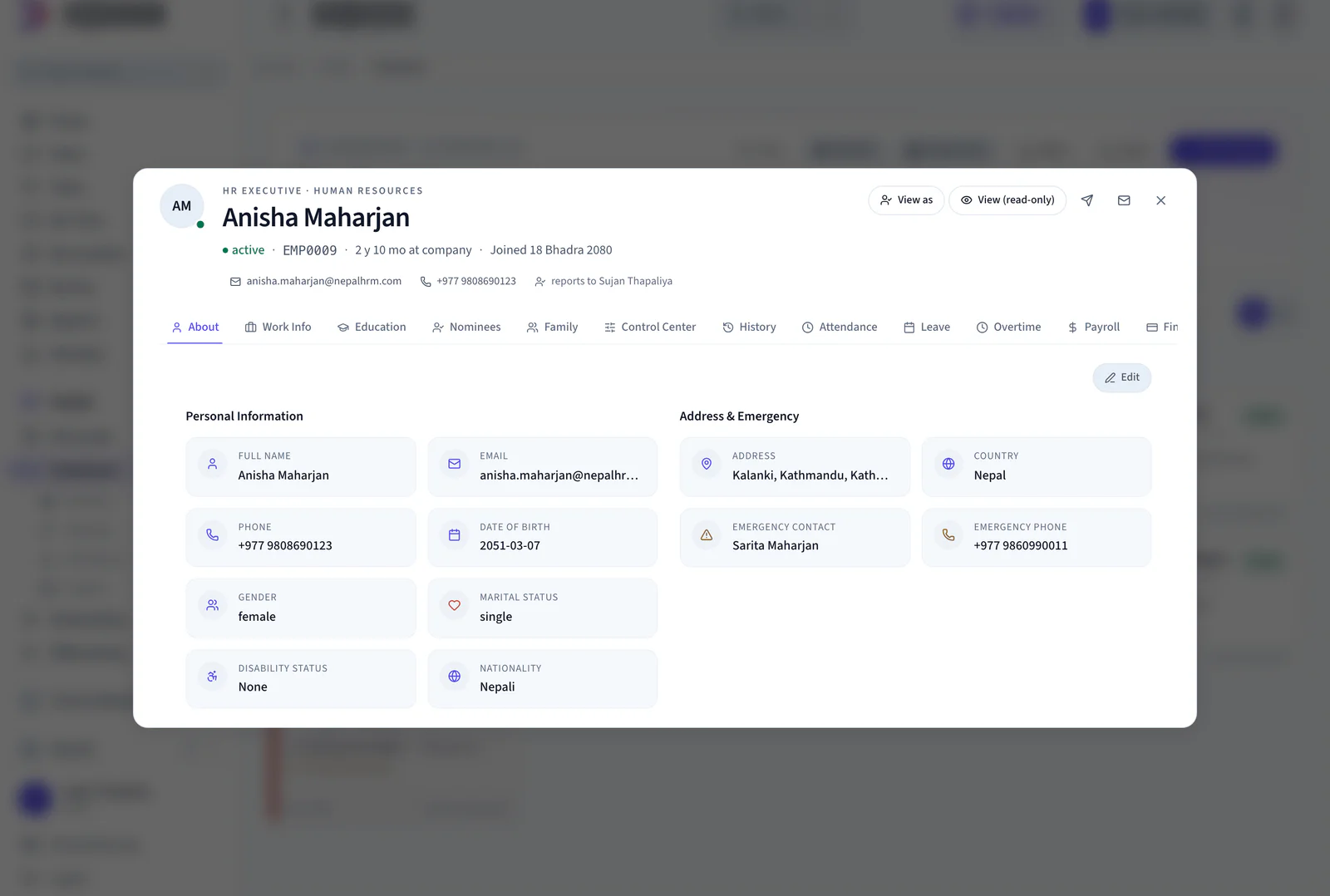
- Each employee record holds the joining date, department, position and employment type, and the profile shows the length of service.
- Changes of designation, department, employment type and salary are logged on the record with their dates, so a letter for someone promoted twice can name each post.
- On Business and Enterprise, offboarding records the resignation date and the last working day.
Experience Letters in Nepal, Answered
Yes, once the employment has ended and the former employee asks for one. Section 150 of the Labour Act 2074 says the employer shall then give a certificate of work experience stating the period of service and the post. While someone is still employed no section requires it, though most employers issue one on request anyway.
By law, the period of service and the post, which Section 150 names. In practice also the company letterhead, a reference number and date, the employee's full name, the employment type, an authorised signature and the company stamp. Responsibilities and a conduct line are optional.
Section 150 attaches no condition to it: it does not depend on how the employment ended, on notice being served or on dues being cleared. Anything owed either way goes through the final settlement, which Section 148(1) requires within 15 days. That is what the section says; it is not advice on a particular dispute.
Yes. The Act calls it a certificate of experience, and Nepali offices use experience letter, experience certificate, work experience certificate and job experience certificate for the same document. Whether it is titled a letter or a certificate matters less than the dates and the post on it.
Both. Your own records are in Bikram Sambat, and most readers outside Nepal work in AD. Print the BS date with the AD date beside it, converted from the published month lengths: BS months run 29 to 32 days, so a fixed offset is usually a day or two out. This generator does that, and counts the length of service in BS.
You can ask, and most employers will issue one worded as "has been employed since". Section 150 applies after the employment has ended, so for a current employee the letter is a courtesy rather than a duty. A bank or an embassy asking about current employment usually wants a salary certificate instead.
No. A relieving letter is not in the Act. In practice it confirms the person was released on a stated date with nothing outstanding, which is a statement about the Section 148 settlement. Many employers fold it into the experience letter with a dues-paid line; add that line only once the settlement has been paid.
Yes. Download for Word saves a .doc file that Word, LibreOffice and Google Docs open for editing, and Print or save as PDF uses your browser's print dialog. The letter is built in your browser, and its contents are not sent anywhere.
Guides to the exit paperwork
What Section 150 obliges, what a relieving letter is, and the settlement clock both sit against.
- Experience and Relieving Letters in Nepal: The RulesSection 150 makes the experience certificate compulsory on request and fixes what it must state. The relieving letter is not in the Act at all. What that changes.
- Full and Final Settlement in Nepal: A Step-by-Step GuideEvery amount a departing employee is owed in Nepal, the fifteen day deadline in Section 148, and the penalty that keeps the salary running if you miss it.
- Termination and Notice Period in Nepal: Employer GuideSeven lawful routes out of an employment relation in Nepal, the notice each needs, the 15-day settlement deadline, and the retrenchment compensation formula.
- Employment Types in Nepal: All Five, Under Section 10Regular, work-based, time-based, casual and part-time employment in Nepal, what separates them, and why the label in your contract does not decide the answer.
While You're Here, Try These Too
Every NepalHRM tool is free, runs in your browser and needs no account. See all of the free Nepal payroll and tax calculators.
Keep the Record the Letter Comes From
NepalHRM holds each employee's joining date, post, department and employment type, with every change logged, so the facts an exit letter needs are already on file.
- Joining date and post on record
- Changes logged with dates
- Offboarding on Business and Enterprise
- Free onboarding