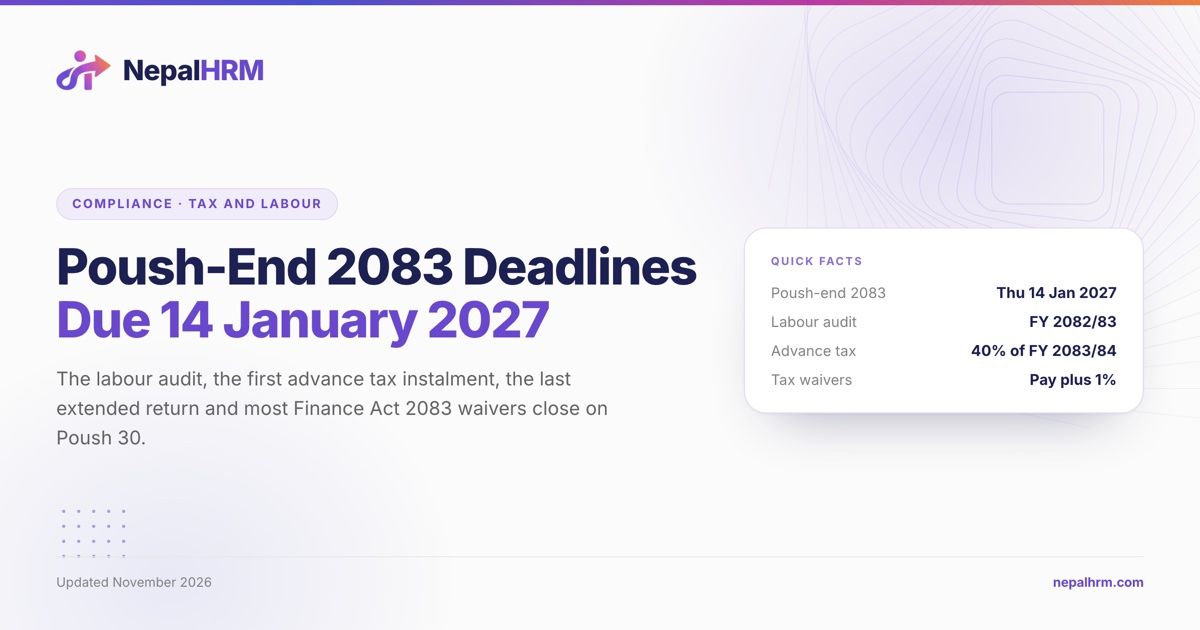
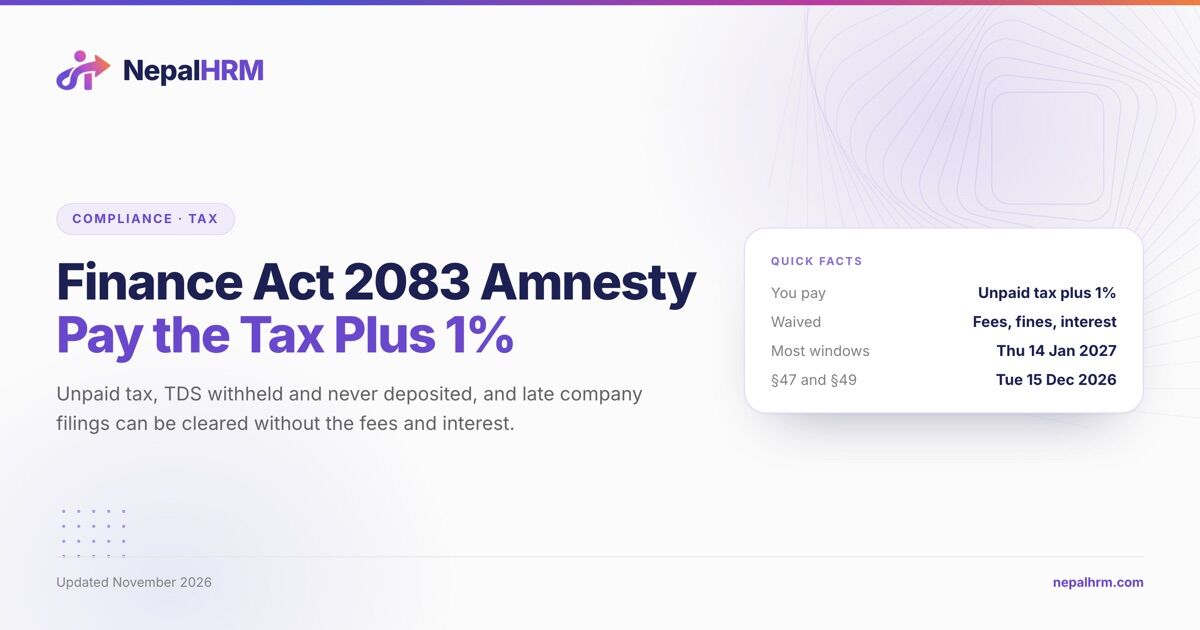
The Finance Act 2083 waives the fees, fines and interest on old tax debts for anyone who pays the tax itself, usually with 1% extra, and files what is missing: unpaid income tax, VAT and excise, TDS withheld from staff and never deposited, unfiled returns, and a company's overdue filings at the Company Registrar. Most windows close at Poush-end 2083, Thursday 14 January 2027. Sections 47 and 49 close a month earlier, at Mangsir-end, Tuesday 15 December 2026.
The Act's own word is मिनाहा (minaha), a waiver, which is why the scheme is searched for as kar minaha. This page is for the owner or accountant of a private company: what each window covers, what still has to be paid, where to go, and the section behind it. It describes the text of the Act and the Inland Revenue Department's booklet on it. It is not advice on your file, and where a window turns on facts, read the section with your CA before you pay.
Table of Contents
- The waiver windows at a glance
- TDS withheld but never deposited: Section 44
- Tax already assessed or under appeal: Sections 45 and 46
- Returns never filed: Section 40
- VAT not collected or not filed: Section 41
- Company filings at the Registrar: Section 48
- The two windows that close at Mangsir-end
- Nothing here for SSF
- Can the deadlines move?
- What to do before Mangsir-end
- Frequently asked questions
- What is the Finance Act 2083 tax amnesty?
- What is the last date for the Finance Act 2083 waiver?
- Can TDS withheld from salaries and never deposited be waived?
- Is there an SSF amnesty in 2083?
- How does a company clear late filings with the Company Registrar?
- Sources
The waiver windows at a glance
| Section | Who it is for | Pay and file by the deadline | Waived | Closes |
|---|---|---|---|---|
| §44 | Returns filed, tax still unpaid on Jestha 15, 2083. The IRD includes TDS withheld and not deposited | The unpaid tax plus 1% | Fees, additional fees, fines, interest and late fees | Poush 30, 2083 · 14 Jan 2027 |
| §45 | Tax assessed by the IRD by Jestha 15, 2083 and still unpaid | The assessed tax plus 1%, then apply to your Inland Revenue Office | Fees, additional fees, fines, remaining interest or late fees | Poush 30, 2083 · 14 Jan 2027 |
| §46 | Assessments disputed at administrative review or in court | Withdraw the case, pay the assessed tax plus 1%, then apply | Fees, additional fees, fines, interest and late fees | Poush 30, 2083 · 14 Jan 2027 |
| §40(1) | Earned taxable income without a PAN | Take a PAN, file returns for FY 2079/80 to 2082/83, pay the tax | Fees and interest. Years before FY 2079/80 need not be filed | Poush 30, 2083 · 14 Jan 2027 |
| §40(2) | PAN holders who never earned or traded and stopped filing | File the FY 2082/83 return, pay its tax, apply to close or resume | Earlier returns. No application, and the PAN is cancelled | Poush 30, 2083 · 14 Jan 2027 |
| §40(3) | PAN holders with income, and tax and returns outstanding | The tax plus 1%, and the returns | Fees and interest | Poush 30, 2083 · 14 Jan 2027 |
| §41 | VAT-registered persons who did not collect, deposit or file | Returns up to Chaitra 2082, and the tax plus 1% | Interest, additional fees and fines | Poush 30, 2083 · 14 Jan 2027 |
| §48 | Companies behind on Registrar filings, renewals, fees or fines | Returns through CAMIS, and what is due for FY 2082/83 | All earlier fees, charges and fines | Poush 30, 2083 · 14 Jan 2027, extended |
| §47 | Resident staff of UN bodies, international organisations and foreign missions | A PAN, returns for FY 2079/80 to 2082/83, the tax plus 1%, then apply | Fees and interest. Earlier years need not be filed | Mangsir 29, 2083 · 15 Dec 2026 |
| §49 | Unpaid levies under past annual Finance Acts | The levy plus 1%, and any missing returns | Fines, interest, additional fees and fees | Mangsir 29, 2083 · 15 Dec 2026 |
The 1% is worked out on the unpaid principal, not on the fees and interest being waived. The sections below take the employer's cases first. For everything else that falls due at the end of Poush, see the Poush-end 2083 deadlines.
TDS withheld but never deposited: Section 44
Section 44 is for a person who filed VAT, income or excise returns and still owed the tax shown on them on Jestha 15, 2083 (Friday 29 May 2026). Pay that tax plus 1% of it by Poush-end 2083 and the fees, additional fees, fines, interest and late fees on it are waived.
The Act does not mention TDS. The IRD's information booklet on the Act does. It says that tax withheld at source and still unpaid, shown as a liability in the financial statements and the income return, is income tax still owed under a filed return, so Section 44 covers it. Its worked example is a manufacturer that withheld NPR 75,000 from a consultant's fee and never deposited it: paying NPR 75,750 by Poush-end clears every fee and interest charge on that amount.
Salary TDS is the case the booklet does not spell out. Its example is a consultant's fee. Tax withheld from salaries sits in the same part of the Income Tax Act 2058, Chapter 17 on tax withheld from payments, under Section 87, and the booklet's rule is written for tax withheld at source in general, so the same reading should hold. Have your CA confirm it against your own returns before you rely on it.
What it takes, in order:
- Find the gap. For every month before the cut-off, compare the TDS the payroll withheld with what the IRD's records show as deposited. The eTDS statement for each month is where the two should have met.
- Check the return. Section 44 needs a filed return that shows the amount as payable. If the company's return for that year was never filed, Section 44 does not fit as written. Ask your CA which section, if any, applies instead.
- Check what the IRD has already done. The booklet says that where an Inland Revenue Office has issued an order under Section 90(8) of the Income Tax Act demanding withheld tax that was not deposited, the waiver comes under Section 45, below. If you appealed that order, it is Section 46.
- Pay the principal plus 1% by Poush 30, 2083. The Act names no application for Section 44, unlike Sections 45, 46 and 47. The booklet requires the return to be on the IRD's integrated tax system already and the principal and the 1% to be paid into the revenue account by Poush-end. Keep the voucher, and ask your Inland Revenue Office to confirm that the fees and interest have come off your account.
The window only reaches tax that was owed on Jestha 15, 2083. Tax that fell due after that date is outside it, and the monthly rule has not changed: TDS is deposited, with its statement, within 25 days of the end of each Nepali month under Section 90 of the Income Tax Act. The rate for each kind of payment is in TDS rates in Nepal.
Tax already assessed or under appeal: Sections 45 and 46
Section 45 covers VAT, income tax and excise that an Inland Revenue Office or the Department assessed, or re-assessed, by Jestha 15, 2083 and that is still unpaid. Pay the assessed tax plus 1% by Poush-end 2083 and the fees, additional fees, fines and the remaining interest or late fees are waived. The booklet asks for an application to the Inland Revenue Office once the payment is made, and adds two limits. An assessment that became final only after Jestha 15 does not qualify, even if the preliminary order came earlier. And the Section 90(8) orders described above, for withheld tax that was never deposited, do qualify.
Section 46 is for the taxpayer who disputed an assessment made by Jestha 15, 2083 and still has the case pending, at administrative review before the Department or before a tribunal or court. Withdraw the case, pay the assessed tax plus 1% by Poush-end 2083, and the fees, additional fees, fines, interest and late fees are waived. The booklet asks for the application to the Inland Revenue Office to carry a copy of the withdrawal application and the bank deposit voucher. Where the Department has taken the case to the Supreme Court, the taxpayer pays the disputed amount plus 1% and applies by the same date, and the government may then withdraw the case.
Neither section applies to a business providing telecommunications services. Both turn on dates and on the state of a case, so take the assessment orders and case papers to your CA before you pay.
Returns never filed: Section 40
Section 40 has three parts, and each fits a different company.
Section 40(1), earned without a PAN. A person who earned taxable income without a PAN and paid no income tax takes a PAN, files the returns for FY 2079/80 to FY 2082/83 and pays the tax on them by Poush-end 2083. The fees and interest are waived, and returns and tax for the years before FY 2079/80 are not required. This part of the Act asks for no 1% extra. Getting the PAN itself is covered in PAN registration in Nepal.
Section 40(2), a PAN that was never used. A taxpayer that took a PAN, never earned or traded, and has not filed returns for FY 2081/82 or earlier files the FY 2082/83 return, pays its tax, and applies to the office by Poush-end 2083 either to cancel the registration or to resume trading. The earlier returns are then not required. Without an application the system cancels the PAN automatically, and bringing it back later means filing every return for the period with its tax, fees and interest. A shelf company or a dormant subsidiary is the usual case. The IRD's booklet also lists 1% extra on the FY 2082/83 tax for this route, which the text of Section 40(2) does not mention, so confirm the amount with your Inland Revenue Office.
Section 40(3), a PAN with debts. A PAN holder that earned income and still owes tax and returns pays that tax plus 1% and files the returns by Poush-end 2083, and the fees and interest are waived.
VAT not collected or not filed: Section 41
Section 41 is for VAT-registered persons. One who made taxable sales without collecting or depositing the VAT pays the tax that should have been collected, plus 1%, by Poush-end 2083 and files the returns up to Chaitra 2082. One who collected VAT but did not file pays the tax shown on those returns plus 1% and files them by the same date. In both cases the interest, additional fees and fines are waived. The booklet notes that a month with nothing to declare still needed a return, and that missing nil returns also come under this section.
Company filings at the Registrar: Section 48
Section 48 is the one window run by the Office of the Company Registrar rather than the IRD. A company registered under the Companies Act 2063 that missed its filings, did not renew, or did not pay its fees, charges, interest or fines can clear all of them if it wants to keep trading or to close. It files what is due for FY 2082/83 and pays the tax, fees and charges the law sets for that year, and the taxes, fees, charges, interest and fines of earlier years are waived.
The Act closed this window at Asoj-end 2083. A Registrar notice dated 2083/07/17 (3 November 2026) extends it to Poush-end 2083, following a Ministry of Finance decision of 2083/07/09 published in the Nepal Gazette on 2083/07/16. The notice asks companies to file the returns for the years before FY 2082/83 as well, through the Registrar's online system CAMIS, by Poush-end, and to pay what the law sets as due. Read the notice itself for what counts as due. The ordinary annual filing and its late-filing fines are covered in the Poush-end deadlines guide.
The two windows that close at Mangsir-end
Section 47 is for individuals, not companies: Nepali citizens or residents working for a UN office in Nepal, a UN body, another international organisation with diplomatic recognition, or a foreign diplomatic mission, whose pay is not exempt under the Vienna Convention and on which no tax was paid. They take a PAN, file the returns for FY 2079/80 to FY 2082/83, pay the tax plus 1% and apply by Mangsir 29, 2083 (15 December 2026). The interest and fees are waived, and earlier years are not required. A company's HR team will not file these, but it is often the team people ask.
Section 49 covers fees, charges and taxes levied under the annual Finance Acts themselves, as distinct from the Income Tax Act or the VAT Act. Whoever did not pay one, paid too little, or missed a return pays the balance plus 1% and files by Mangsir-end 2083. Where an office has already assessed the amount, or a case is pending in a court or tribunal, any case is withdrawn and the assessed amount plus 1% is paid by the same date. The fines, interest, additional fees and fees are waived. The booklet's examples are the telecommunications service charge and the digital services tax, so most employers will have nothing here.
Nothing here for SSF
None of Sections 40 to 49 covers Social Security Fund contributions. They deal with taxes the IRD collects, levies under the annual Finance Acts, and company dues at the Registrar. A late SSF deposit is still handled under the Fund's own rules; see monthly SSF contributions.
The Act has other waivers that are outside this page, among them Section 38 for organisations registered under the Associations Registration Act 2034 and Section 43 for excise.
Can the deadlines move?
They can. Section 19 of the Act lets the Ministry of Finance extend a period by a notice in the Nepal Gazette where the Act's facilities cannot be used or its implementation runs into difficulty, and the company window above has already been extended by a Ministry decision published in the Gazette. The IRD's booklet, revised on Asoj 26, 2083, still gives the dates in the table for the tax windows. Plan to the published date and check the IRD and Registrar notices before relying on a later one.
The monthly deadlines do not pause either. The TDS withheld from Mangsir salaries is due by Poush 25, 2083 (Saturday 9 January 2027), in the same weeks as these payments. The payroll compliance calendar for FY 2083/84 has the full year.
What to do before Mangsir-end
- List the debts. Unpaid TDS by month, unpaid VAT, open assessments, open appeals, missed Registrar filings, and any PAN in the group that has gone quiet.
- Match each one to a section. Use the table above, and mark the cases that turn on a date or a filed return for your CA.
- Settle anything under Section 47 or 49 first. Those close on 15 December 2026.
- Pay the rest early in Poush. The tax windows and the Registrar window all end on Thursday 14 January 2027, alongside the other Poush-end deadlines.
- Keep the evidence. Deposit vouchers, the applications for Sections 45, 46 and 47, and the CAMIS acknowledgement.
The first step is a payroll report, not a forensic exercise. NepalHRM calculates the TDS on every salary in the monthly payroll run and produces the eTDS file from the closed run, so the tax withheld for each month is on record. Depositing it, and paying any waiver amount, stays with your finance team. See how payroll and compliance work, or book a walkthrough.
Frequently asked questions
What is the Finance Act 2083 tax amnesty?
It is a set of one-time windows in the Finance Act 2083 (also published as the Economic Act 2083), most of them in Sections 40 to 49. A taxpayer who pays the outstanding tax, usually with 1% extra, and files what is missing by the deadline has the fees, fines and interest on it waived. Separate sections cover unpaid tax on filed returns, assessed tax, tax under appeal, unfiled returns, VAT, company filings at the Registrar, and levies under past Finance Acts.
What is the last date for the Finance Act 2083 waiver?
Poush 30, 2083, which is Thursday 14 January 2027, for Sections 40, 41, 44, 45 and 46, and for the company filing window under Section 48 as extended by the Office of the Company Registrar. Sections 47 and 49 close earlier, on Mangsir 29, 2083, Tuesday 15 December 2026.
Can TDS withheld from salaries and never deposited be waived?
The IRD's booklet on the Act treats tax withheld at source and still unpaid, shown as payable in a filed return, as income tax under Section 44. Paying it plus 1% by Poush-end 2083 waives the fees, interest and fines. The booklet's example is TDS on a consultant's fee; salary TDS is withheld under the same chapter of the Income Tax Act, but confirm it with your CA. If the IRD has already issued an order demanding the amount, the route is Section 45.
Is there an SSF amnesty in 2083?
Not in the Finance Act 2083. None of its waiver sections, 40 to 49, covers Social Security Fund contributions. Late SSF deposits stay under the Fund's own rules.
How does a company clear late filings with the Company Registrar?
Through Section 48 of the Finance Act 2083, extended to Poush-end 2083 by the Registrar's notice of 2083/07/17. A company that wants to keep trading or to close files its returns through CAMIS and pays what is due for FY 2082/83, and the fees, charges and fines for earlier years are waived.
Sources
- Economic Act (Finance Act), 2083, Act No. 10 of 2083, Nepal Gazette Part 2, Volume 76, Extraordinary Issue 29, dated 2083/03/30, as published by the Inland Revenue Department: ird.gov.np. Sections 19, 40, 41 and 44 to 49. Read 2026-11-05.
- Inland Revenue Department, information booklet on tax waivers, concessions and other provisions of the Finance Act 2083 (revised edition), dated Asoj 26, 2083: ird.gov.np. The treatment of withheld tax under Sections 44 and 45, the conditions and applications for each window, and the NPR 75,000 example. Read 2026-11-05.
- Office of the Company Registrar, notice extending the Section 48 period, dated 2083/07/17: ocr.gov.np. Read 2026-11-05.
- Income Tax Act, 2058, consolidated Nepali text as amended by the Finance Act 2082, Inland Revenue Department: ird.gov.np. Chapter 17, Sections 87 and 90.
- Dates: BS 2083 month lengths as used by NepalHRM's Nepali date converter, which agree with the Ministry of Home Affairs holiday notice for 2083.
Related reading: Poush-end 2083 deadlines · TDS rates in Nepal for FY 2083/84 · Payroll compliance calendar for FY 2083/84