NepalHRM
Free Appraisal Form

Performance Appraisal Form for Nepal: KPIs, Ratings and Sign-off

A ready employee appraisal form: the review period in BS, a KPI table with weight, target, actual and score, competency ratings, strengths, development areas, the employee's comments and signatures. Download it for Excel, where the scores are formulas, or print it blank.

  • Weighted KPI score as formulas
  • Built on Section 112
  • Excel or print
  • No sign-up

What the law and the form say

Ordinarily, under Section 112(1)
Once a year
Keep each form, Rule 63(3)
3 years
Scale, scored by formula
1–5
Examples for five roles
25 KPIs

Download the appraisal form, or print it blank

The Excel file has three tabs: the blank form, the worked example below, and the KPI examples for five roles. Type in the blue cells. The weighted scores, the totals and the overall rating are formulas, and every score cell takes 1 to 5 only. The print button gives the same form blank, to fill in by hand.

Download the form (Excel)

Performance appraisal form: a worked example

कार्यसम्पादन मूल्याङ्कन फाराम

Accountant · FY 2082/83 · Annual review

1. Employee and review details

Company
Your Company Pvt. Ltd.
Fiscal year evaluated
2082/83
Employee name
Ramesh Thapa
Employee ID
EMP-0142
Designation (post)
Accountant
Department
Finance
Date of joining (BS)
1 Magh 2079
Review type
Annual
Period from (BS)
Shrawan 2082
Period to (BS)
Ashad 2083
Reviewer (name, post)
Kabita Adhikari, Finance Head
Discussion held on (BS)
12 Shrawan 2083

2. Rating scale

  • 5 Outstanding
  • 4 Exceeds expectations
  • 3 Meets expectations
  • 2 Needs improvement
  • 1 Unsatisfactory

3. Key performance indicators (KPIs)

Agree the KPIs, weights and targets with the employee before the period begins (Labour Act 2074, Section 112(3)). The weights should total 100%.

KPIs for Ramesh Thapa, Accountant, FY 2082/83
#KPI and how it is measuredWeightTargetActualSelfReviewerWeighted
1Month-end close on timeDay of the next BS month by which the books are closed and the trial balance is ready25%By day 7, every monthBy day 7 in 10 of 12 months430.75
2Statutory deposits on timeMonths in which TDS, SSF and VAT were deposited and filed by their due dates25%12 of 12 months, no late fee12 of 12 months, no late fee541.00
3Bank reconciliationBank accounts reconciled each month with no unexplained difference20%Every account, every monthEvery account; one difference cleared a month late330.60
4Accuracy of entriesCorrections found in the manager's review or the audit15%Fewer than 5 a quarter3 a quarter on average440.60
5Receivables follow-upShare of receivables more than 90 days old at the month end15%Below 10%14% at the year end320.30
Total100%KPI score, out of 53.25

KPIs agreed on (BS): 5 Shrawan 2082, signed by both. The form has room for 6 KPIs.

4. Competencies

Rate each competency from 1 to 5 on what the employee actually did in the period.

Competency ratings for Ramesh Thapa
#Competency and what a 3 looks likeSelfReviewer
1Job knowledgeKnows the rules, systems and products the role uses, and keeps up when they change.44
2Quality of workWork is accurate and complete the first time and needs little checking.43
3CommunicationKeeps the manager and colleagues informed, in writing where it matters.33
4TeamworkHelps colleagues, shares information and handles disagreement politely.44
5Initiative and problem solvingSpots problems early, proposes a fix and acts within the role's authority.43
6Reliability and punctualityKeeps working hours and deadlines, and raises a delay before it happens.44
Competency score, out of 53.50

5. Overall rating

The overall score blends the KPI score and the competency score by the split beside them. The rating is read from the scale in section 2.

KPI score · 70% of overall
3.25
Competency score · 30% of overall
3.50
Overall rating
3.33
Meets expectations

6. Strengths

After scoring, discuss the strengths and the weaknesses with the employee and agree how to improve (Section 112(4)).

Every TDS, SSF and VAT deposit was on time across the year with no late fee, and the quarterly corrections stayed well under the target.

7. Development areas and the support agreed

Receivables over 90 days ended the year at 14% against a 10% target. Agreed: a monthly ageing report to the sales head, and a follow-up call list from the first week of each month. The month-end close slipped past day 7 twice; the bank statements will be downloaded on day 1.

8. Employee's comments

An employee who disagrees records it here and still signs the form (Section 112(5)). The disagreement then goes to review (Section 112(6)).

Does the employee agree with the evaluation? Agree

I agree with the scores. Two large customers paid late in Chaitra. I will send the ageing report every month from Shrawan.

9. Review of a disagreement

Left blank here, because the employee agreed. When an employee disagrees, the person reviewing it, the date and the outcome go here, as Section 112(6) requires a review to be arranged.

10. Signatures

  • EmployeeRamesh ThapaSignature · 14 Shrawan 2083
  • ReviewerKabita AdhikariSignature · 14 Shrawan 2083
  • Approved by (HR or head of office)Sita Sharma, HR OfficerSignature · 15 Shrawan 2083

Keep the signed form for at least three years (Labour Rules 2075, Rule 63(3)).
KPI examples

KPI Format and Examples for Five Roles

Measurable KPIs with a weight for an accountant, a sales officer, an HR officer, a customer service officer and field staff. The targets are placeholders: replace them with your own figures before the period begins.

Accountant

  • Month-end close on time25%

    Day of the next BS month by which the books are closed and the trial balance is ready

    Example target: By day 7, every month

  • Statutory deposits on time25%

    Months in which TDS, SSF and VAT were deposited and filed by their due dates

    Example target: 12 of 12 months, no late fee

  • Bank reconciliation20%

    Bank accounts reconciled each month with no unexplained difference

    Example target: Every account, every month

  • Accuracy of entries15%

    Corrections found in the manager's review or the audit

    Example target: Fewer than 5 a quarter

  • Receivables follow-up15%

    Share of receivables more than 90 days old at the month end

    Example target: Below 10%

Sales officer

  • Sales against target35%

    Invoiced sales in the period, net of returns, against the territory's target

    Example target: 100% of the annual target

  • New customers20%

    Customers billed for the first time in the period

    Example target: 2 a month

  • Collection within terms20%

    Share of invoiced value collected within the agreed credit days

    Example target: 90% or more

  • Visit plan completed15%

    Planned customer visits done and logged

    Example target: 95% of the plan

  • Reports on time10%

    Weekly sales report submitted by the agreed day

    Example target: Every week

HR officer

  • Time to fill vacancies25%

    Days from an approved requisition to an accepted offer

    Example target: Within 30 days

  • Payroll inputs on time25%

    Months in which attendance, leave, joiners and leavers reached payroll by the cut-off without rework

    Example target: 12 of 12 months

  • Contracts before day one15%

    New joiners with a signed employment contract on their first day

    Example target: Every joiner

  • Appraisals completed15%

    Staff whose appraisal form is filled, discussed and signed by the date the by-laws set

    Example target: 100% of staff

  • Final settlement on time20%

    Leavers paid everything owed within 15 days of the employment ending

    Example target: Every leaver

Customer service officer

  • First response time20%

    Working hours from a customer's call, message or email to the first reply

    Example target: Within 1 working hour

  • Resolved on time30%

    Share of complaints closed within the time promised to the customer

    Example target: 90% or more

  • Customer satisfaction20%

    Average rating, out of 5, in the short survey after each closed complaint

    Example target: 4 or higher

  • Quality check15%

    Share of sampled calls or tickets that pass the team's checklist

    Example target: 90% or more

  • Repeat complaints15%

    Complaints reopened for the same issue within 30 days

    Example target: Below 5%

Field staff

  • Visit plan completed30%

    Planned field visits done and reported on the day

    Example target: 95% of the plan

  • Right first time25%

    Jobs, orders or collections completed without a second visit

    Example target: 90% or more

  • Same-day reporting15%

    Visit reports submitted the same working day

    Example target: Every working day

  • Cash deposited on time15%

    Money collected in the field deposited by the next working day

    Example target: Every collection

  • Safety and equipment15%

    Incidents, and equipment lost or damaged, in the period

    Example target: No incident, nothing lost

Writing a KPI of your own

  • Measurable: a number, a date or a done-or-not, read from a record both sides can see.
  • Within the person's control. A sales officer can chase collections, but cannot set the exchange rate.
  • Four to six, with weights that total 100%, the heaviest on what the role exists for.
  • Agreed before the period begins, which Section 112(3) requires of the basis of the evaluation.

All five sets are on the KPI examples tab of the Excel download, with each role's weights totalled by a formula. Copy a role's rows into the form's KPI table and change the targets.

Either side of a review

The Papers That Come Before and After an Appraisal

  • Job description generator

    The duties a role's KPIs should measure. Agree the job description first, then the KPIs that show the job is being done.

  • Probation confirmation letter

    For a review at the end of probation, which Section 13 caps at 6 months. The confirmation letter and the other HR letters each carry the section behind them.

  • Attendance sheet template

    The record behind a punctuality rating: a BS month in Excel with Saturdays and the public holidays marked.

Running a review cycle

Four Steps, One Signed Form

Section 112 of the Labour Act 2074 and Rule 63 of the Labour Rules 2075 set the order. The form has a place for each step.

  1. 1

    Agree the KPIs before the period

    Write four to six KPIs with a weight, a target and how each is measured, and both sign the agreement line. Section 112(3) requires the basis and procedure of the evaluation to be made known to the employee before the period begins.

  2. 2

    The employee fills in the self scores

    At the start of the fiscal year, Rule 63(3) has the employer give each employee the previous year's form to fill in, and Rule 63(2) has the employer provide that form. The self score columns are theirs.

  3. 3

    Score it, then talk it through

    The reviewer enters the actual results and scores each KPI and competency from 1 to 5, and the weighted scores and overall rating calculate. Section 112(4) then requires a discussion of strengths and weaknesses and a reasonable chance to improve.

  4. 4

    Comments, signatures, file

    The employee records agreement or disagreement and signs either way (Section 112(5)); a disagreement goes to review (112(6)). Keep the signed form for at least 3 years under Rule 63(3).

Last updated · Reviewed by Rajendra Regmi, Co-founder

The rating scale

Five Ratings, and Where Each One Starts

Every KPI and competency is scored from 1 to 5. The overall score blends the two, 70% KPIs and 30% competencies unless you change the split, and the rating is read from this table.

ScoreRatingWhat it meansOverall score from
5OutstandingWell above target on most measures, in a way others can learn from.4.5
4Exceeds expectationsAbove target on most measures and below it on none.3.5
3Meets expectationsOn target: the work agreed at the start of the period, done in full.2.5
2Needs improvementBelow target on some measures. A plan to close the gap is agreed.1.5
1UnsatisfactoryWell below target, and gaps raised earlier were not closed.1.0

Write the scale and its cut-offs into your by-laws. Rule 63(1) evaluates performance on the basis and procedure the by-laws set, and Section 142(1) counts evaluations that find performance unsatisfactory or below standard, so the by-laws should say which ratings those are.

What the law asks of an appraisal

Section 112 and Rule 63, Point by Point

Read in the consolidated Nepali text of the Labour Act 2074 and in the Labour Rules 2075. This is what the text says, not advice on a particular case.

01

Once a year, ordinarily

Section 112(1) lets an establishment evaluate an employee's performance, ordinarily once a year. Rule 63(1) then says the employer shall evaluate it, on the basis and by the procedure the establishment's by-laws set.

02

A fair basis, told in advance

The basis and procedure have to be just and reasonable (Section 112(2)) and made known to the employee before the period being evaluated begins (112(3)). KPIs written after the year has ended do not meet it.

03

The employee gets the form

Rule 63(2): the employer provides the form to each employee being evaluated. Rule 63(3): at the start of the fiscal year each employee fills in the form for the previous fiscal year, and the employer evaluates it.

04

Strengths and weaknesses, discussed

After the evaluation the employer, or someone it designates, discusses the employee's strengths and weaknesses with them and gives a reasonable opportunity to improve (Section 112(4)). The form's strengths and development boxes are where that conversation is written down.

05

Disagreement recorded, then reviewed

An employee who disagrees is given the chance to record the disagreement and then signs the form (112(5)), and the establishment arranges for it to be reviewed (112(6)). The form's last two parts, before the signatures, hold both.

06

Keep it 3 years

Rule 63(3) requires the form to be kept for at least 3 years. Attendance and remuneration records fall under a different rule, Rule 81(3), which sets 5 years. File the signed form, not only the spreadsheet, with the employee's record.

One form here · every review in the app

Appraisals That Run on Screen

Fill in this form free. Performance management in NepalHRM is on the Business and Enterprise plans, and runs the same review with self and manager ratings.

  • Objectives cascade from company to department, team and individual goals, and a goal's progress rolls up into its parent.
  • A competency framework gives each competency a 1 to 5 rubric and each job position the level it expects.
  • A published or acknowledged appraisal prints as a Performance Evaluation Report PDF: self and manager ratings per criterion, comments, the HR decision and lines for signatures.
See NepalHRM performance management
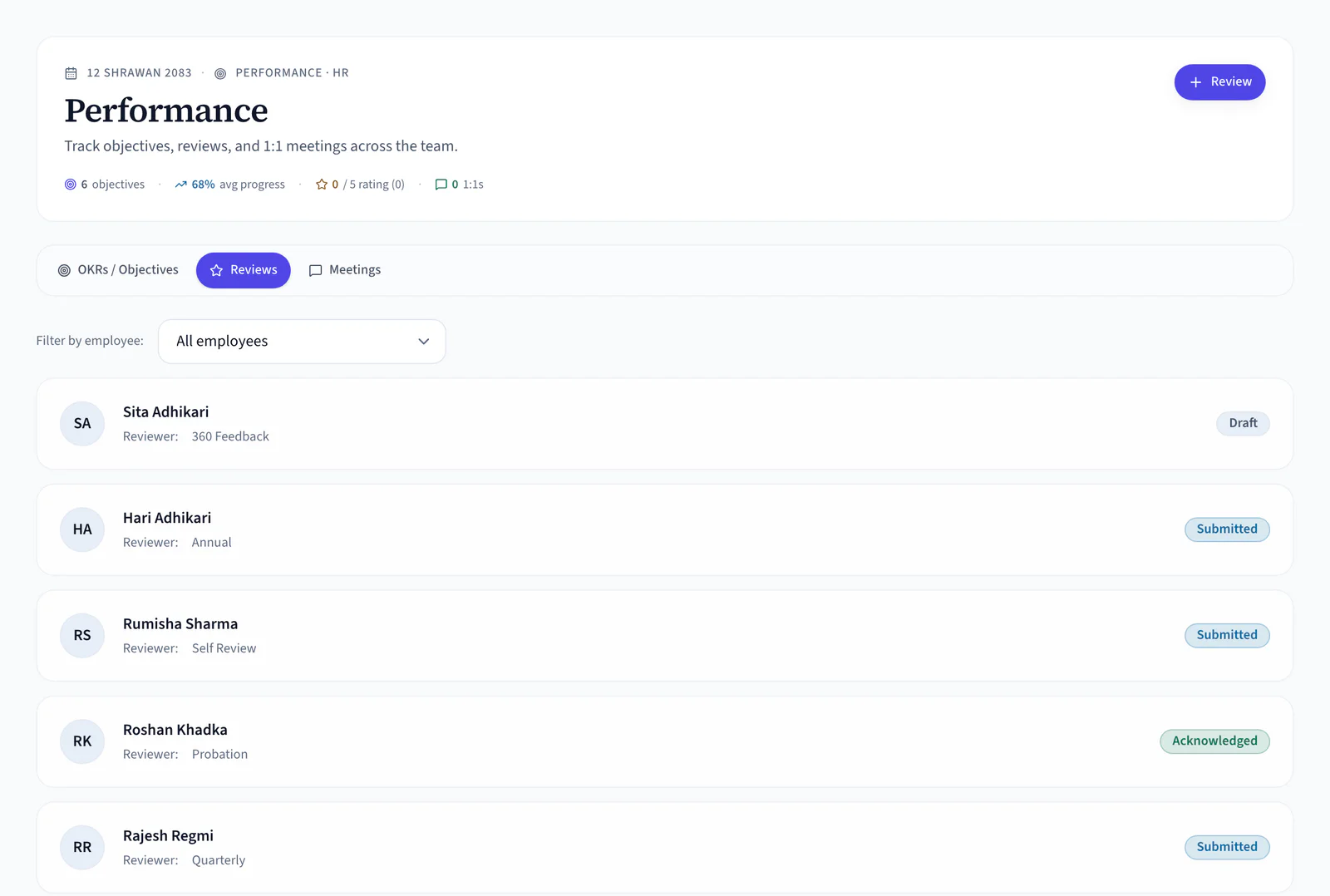
The Reviews tab in NepalHRM performance listing quarterly, annual, self and 360 degree reviews with their draft, submitted and acknowledged status
FAQs

Performance Appraisals in Nepal, Answered

The record of one employee's review for a period: who was reviewed and by whom, the KPIs agreed at the start with their weights and targets, the results and scores, competency ratings, strengths and development areas, the employee's comments and the signatures. This one works out the weighted KPI score and the overall rating for you in Excel.

Section 112(1) of the Labour Act 2074 is worded as a permission: an establishment may evaluate performance, ordinarily once a year. Rule 63 of the Labour Rules 2075 makes it a duty: the employer shall evaluate on the basis and procedure its by-laws set, provide the form, and at the start of each fiscal year have the previous year's form filled in and evaluated. That is what the text says, not advice on a particular case.

At least 3 years, under Rule 63(3) of the Labour Rules 2075. Attendance and remuneration records are a separate rule, Rule 81(3), which sets at least 5 years. Keep the signed copy, not only the spreadsheet.

Section 112(5) gives the employee the chance to record the disagreement on the form, and the employee then signs it. Section 112(6) requires the establishment to arrange a review of the disagreement. This form has a line for the employee to mark Agree or Disagree with a comments box, and a part for who reviewed the disagreement, when and the outcome.

Section 142(1) of the Labour Act 2074 lets the employer end the employment where performance evaluations carried out under the Act, the Rules or the by-laws find performance unsatisfactory or below standard 3 or more times in a row, and 142(2) requires those evaluations to have been carried out as provided. An employer with 10 or more employees gives at least 7 days to submit a clarification first (142(3)). One poor rating is not enough, which is why the basis and procedure belong in the by-laws. This is what the section says, not advice on a particular case.

Each KPI's weight times the reviewer's score from 1 to 5, added up and divided by the total weight. In the worked example an accountant's five KPIs, weighted 25%, 25%, 20%, 15% and 15%, score 3, 4, 3, 4 and 2, which gives a KPI score of 3.25. The competency score of 3.5 is blended in at 30%, for an overall 3.33: Meets expectations.

कार्यसम्पादन मूल्याङ्कन (karyasampadan mulyankan), and the form is the कार्यसम्पादन मूल्याङ्कन फाराम. Section 112 of the Labour Act 2074 and Rule 63 of the Labour Rules 2075 use the same term, so a by-law or notice about appraisals written in Nepali uses it too.

Yes. Upload the .xlsx to Google Drive and open it with Google Sheets. The formulas come across, so the weighted scores and the overall rating keep working. Or print the blank form and fill it in by hand.

Run Appraisals Without Chasing Paper

A form like this goes out to every employee, comes back, gets scored, discussed, signed and filed. On Business and Enterprise, NepalHRM runs the review on screen and prints the report for signature.

  • Self and manager ratings
  • 1 to 5 competency rubric
  • Report PDF for signature
  • Free onboarding