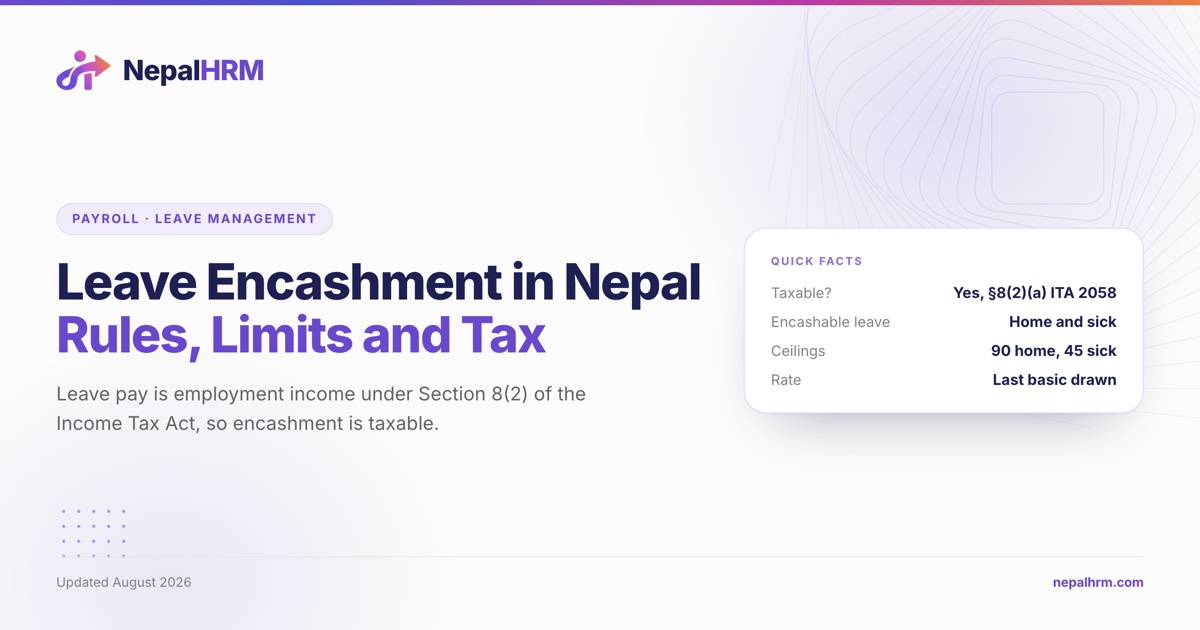
Leave encashment is taxable in Nepal, and the Income Tax Act does not leave it to interpretation. Section 8(2)(a) lists the payments that must be included when computing remuneration from employment, and बिदा बापतको रकम (the amount in respect of leave) is named there alongside wages, salary, overtime and bonus.
That single clause settles a question Nepali HR forums argue about constantly, usually by importing guidance written for a jurisdiction that does exempt part of it. This guide covers what is encashable under the Labour Act, the two ceilings, the rate it is paid at, and how the tax actually lands, which depends more on when it is paid than on how much. It sits under our guide to leave types under the Labour Act.
Table of Contents
- What is encashable, and when
- The two ceilings are different numbers
- What the days are worth
- How it is taxed
- Why timing costs more than the amount
- The settlement deadline nobody diaries
- What to check this quarter
- Frequently asked questions
- Is leave encashment taxable in Nepal?
- Which leave can be encashed in Nepal?
- How is leave encashment calculated in Nepal?
- How much leave can be accumulated in Nepal?
- Can an employee encash leave without resigning?
- Is TDS deducted on leave encashment in Nepal?
- When must leave encashment be paid on resignation?
- Sources
What is encashable, and when
The Labour Act creates three separate moments, and only two of them are obligations.
| When | What is paid | Section | |
|---|---|---|---|
| Annual excess | End of each year | Days accumulated above the ceiling | 49(3) |
| On separation or death | Leaving service | The accumulated balance | 49(2) |
| On request while in service | — | Nothing the Act requires | policy only |
Section 49(3) is the one most policies ignore. Where a worker accumulates leave beyond the Section 49(1) ceilings, they receive the amount for that excess at their basic rate at the end of each year. It is not lost and it is not carried forward, which means a "use it or lose it" clause operating above the cap is not what the Act says.
Section 49(2) covers separation: where a worker ceases to be in service for any reason, or dies, the lump sum for accumulated home leave and sick leave is paid to them or to their prescribed family member.
There is no statutory right to encash a balance below the ceiling while still employed. Many companies allow it as policy. That is lawful, and it is a company benefit rather than a legal entitlement. Label it as such in the policy, because benefits can be revised and entitlements cannot.
The two ceilings are different numbers
Section 49(1) sets ninety days for home leave and forty-five days for sick leave.
This is the most-copied error in Nepali HR writing. The widely republished summaries of this Act state one flat ninety covering both, which overstates a sick-leave payout by up to forty-five days of basic pay for every long-serving employee on the books.
| Home leave | Sick leave | |
|---|---|---|
| Accrual | 1 day per 20 worked, §43(1) | 12 days a year, §44(1) |
| Accumulation ceiling | 90 days | 45 days |
| Above the ceiling | Paid out each year, §49(3) | Paid out each year, §49(3) |
| On leaving or death | Lump sum, §49(2) | Lump sum, §49(2) |
| Encashable | Yes | Yes |
The last row is worth stating plainly because so many policies deny it: Section 49(2) encashes accumulated sick leave as well as home leave. See leave encashment for the term, and our leave calculator to price a specific balance.
What the days are worth
Section 49(2) fixes the rate: the last basic remuneration drawn.
Three things follow, and each is a common policy error:
- Basic, not gross. Dearness and other allowances do not enter the calculation. See basic salary.
- The last rate, not the historic rate. A recent increment raises the value of leave earned years earlier, so the liability moves every time you run a salary revision.
- The divisor is convention, not statute. The Act fixes the entitlements but never states how a monthly figure becomes a daily one. Nepali payroll practice divides by a flat thirty regardless of the length of the month, and that is what the worked example below uses. It is settled practice, not a rule you can cite.
A worked example, computed at both ceilings for an employee on a monthly gross of NPR 85,000 with basic at 60 percent:
| Monthly basic | NPR 51,000 |
| Daily rate (basic ÷ 30, by convention) | NPR 1,700 |
| Accumulated days (90 home + 45 sick) | 135 |
| Gross encashment | NPR 229,500 |
That is the maximum a single employee's accumulated balance can reach under Section 49(1), and it is roughly four and a half months of basic pay sitting on the balance sheet, per long-serving employee, usually unrecorded.
How it is taxed
Income Tax Act 2058, Section 8(1) treats remuneration received from employment in an income year as that person's employment income for the year. Section 8(2)(a) then lists what must be included in that remuneration:
wages, salary, amount in respect of leave, amount for working overtime, fees, commission, prize, gift, bonus and payment for other facilities.
Leave pay is there by name. Section 8(3) excludes amounts exempt under Section 10 and payments subject to final withholding, and provides no exclusion for leave encashment.
So the treatment is ordinary:
- The encashment is added to employment income for the year in which it is paid.
- It is taxed at the personal income tax slab rates for that year.
- Tax is withheld by the employer at payment, the same as on salary.
There is no separate leave-encashment relief in the Act. Exemptions that exist in other jurisdictions do not transfer, and guidance written for them is the usual source of the belief that some portion is tax-free in Nepal.
One distinction worth keeping clear: leave encashment is not a retirement payment. Gratuity and provident fund routed through an approved retirement fund or the Social Security Fund have their own treatment under the Act. Leave encashment is ordinary Section 8 remuneration and does not inherit it. Our guides to gratuity in Nepal and the four SSF schemes cover those separately.
Why timing costs more than the amount
Because the payout lands in a single income year, a large balance can cross a slab boundary that the same days would never have crossed if they had been paid annually.
Take the same employee, on the FY 2083/84 slabs, as an SSF assessee:
| Without the payout | With the payout | |
|---|---|---|
| Annual gross | NPR 1,020,000 | NPR 1,020,000 |
| Leave encashment | — | NPR 229,500 |
| Less SSF contribution for the year | NPR 67,320 | NPR 67,320 |
| Taxable income | NPR 952,680 | NPR 1,182,180 |
| Annual tax | NPR 0 | NPR 18,218 |
Without the payout the employee sits below the first band's ceiling and, as an SSF assessee, pays nothing. The encashment carries NPR 182,180 of income across that boundary into the next band, and the resulting tax is NPR 18,218, an effective rate of 7.9 percent on the payout.
The lesson is not that encashment should be avoided. It is that Section 49(3)'s annual payout is also the tax-efficient one: paying the excess above the ceiling every year, as the Act requires, spreads income that a single separation payout bunches. Companies that ignore Section 49(3) and settle everything at exit are choosing the more expensive outcome for their employee, on top of carrying an unrecorded liability.
Figures above are generated from the FY 2083/84 slabs in this site's payroll module. To model a specific salary, use our salary tax calculator.
The settlement deadline nobody diaries
Section 148 of the Labour Act requires all dues to be paid within fifteen days, and where they are not, the worker is treated as if still in service for the purpose of that remuneration.
Leave encashment is part of that settlement. A final settlement that stalls while somebody reconstructs a leave balance from spreadsheets is not merely slow, it continues to accrue. Our guide to termination and notice period covers what else lands in that fifteen-day window.
What to check this quarter
- Does your policy encash sick leave, or only home leave?
- Are the ceilings 90 and 45, or one flat number?
- Is the rate the last basic drawn, and on basic rather than gross?
- Does anything pay out the excess above the ceiling at year end, per Section 49(3)?
- Is the encashment run through payroll with tax withheld, or paid as a separate untaxed cheque?
- Is any mid-service encashment labelled as company policy rather than entitlement?
- Do you know the total accumulated balance across the workforce, priced at current basic?
Leave encashment is a balance-sheet number long before it is a payslip line. NepalHRM accrues each leave type against its own ceiling, prices the balance at current basic, and carries an approved payout onto the payslip so the tax is withheld with the rest of the month rather than settled off-system. See how leave management works, or book a walkthrough with your own balances.
Frequently asked questions
Is leave encashment taxable in Nepal?
Yes. Section 8(2)(a) of the Income Tax Act 2058 expressly includes the amount in respect of leave in the remuneration to be counted as income from employment, and Section 8(3) provides no exclusion for it. It is taxed at ordinary personal slab rates in the income year it is paid, with tax withheld by the employer.
Which leave can be encashed in Nepal?
Accumulated home leave and sick leave. Section 49(2) of the Labour Act 2074 pays a lump sum for both when the worker ceases to be in service or dies. Section 49(3) separately pays out, at the end of each year, any leave accumulated above the ceilings.
How is leave encashment calculated in Nepal?
Accumulated days multiplied by a daily rate derived from the last basic remuneration drawn, under Section 49(2). Basic rather than gross, and the last rate drawn rather than the rate in force when the leave was earned. The Act does not state the divisor for converting a monthly figure to a daily one; Nepali payroll convention uses a flat thirty-day month.
How much leave can be accumulated in Nepal?
Ninety days of home leave and forty-five days of sick leave, under Section 49(1). They are two different ceilings. Leave accumulated above them is paid out at the end of each year at the basic rate under Section 49(3), so it is neither carried forward nor forfeited.
Can an employee encash leave without resigning?
The Labour Act requires it only in two cases: the annual payout of leave above the ceiling under Section 49(3), and the lump sum on separation or death under Section 49(2). Encashing a balance below the ceiling while still in service is permitted as company policy but is not a statutory entitlement.
Is TDS deducted on leave encashment in Nepal?
Yes. Because the payment is remuneration from employment under Section 8(2)(a), the employer withholds tax on it as it does on salary, and it forms part of the employee's employment income for that year.
When must leave encashment be paid on resignation?
Within fifteen days, under Section 148 of the Labour Act 2074, along with the rest of the worker's dues. Where the payment is not made in time, the worker is treated as remaining in service for the purpose of that remuneration.
Sources
- Income Tax Act, 2058 (2002), consolidated Nepali text as amended by the Finance Act 2082, Inland Revenue Department: ird.gov.np. Section 8 was read from the Act's own text, retrieved 2026-08-07.
- Labour Act, 2074 (2017), consolidated Nepali text as amended through 2082, Nepal Law Commission: lawcommission.gov.np. Sections 43, 44, 49 and 148 read from that text, retrieved 2026-08-07.
- Tax figures generated from this site's FY 2083/84 payroll module rather than typed by hand.
Related reading: Leave types under the Labour Act 2074 · How to write a leave policy for a Nepali company · Sick, maternity and paternity leave in Nepal